





Professional Industrial Band Heating Element Heater
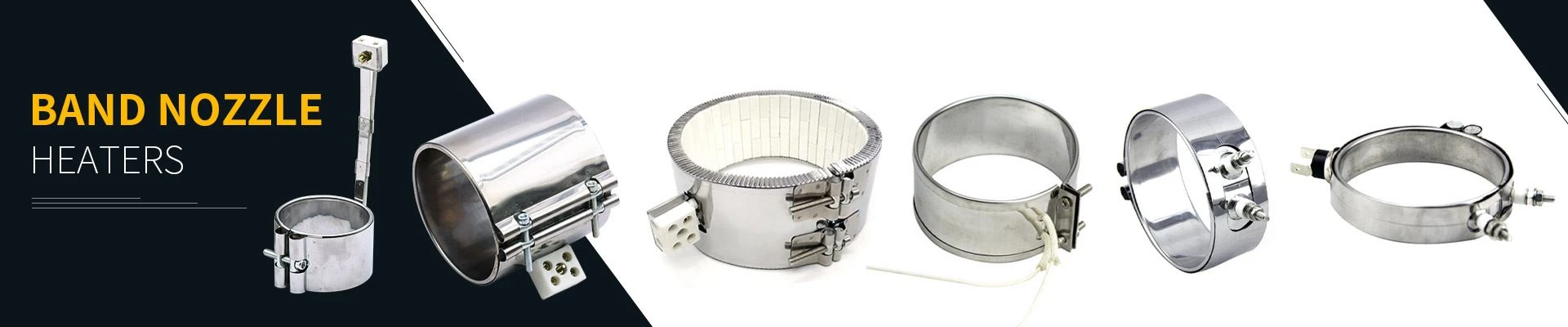
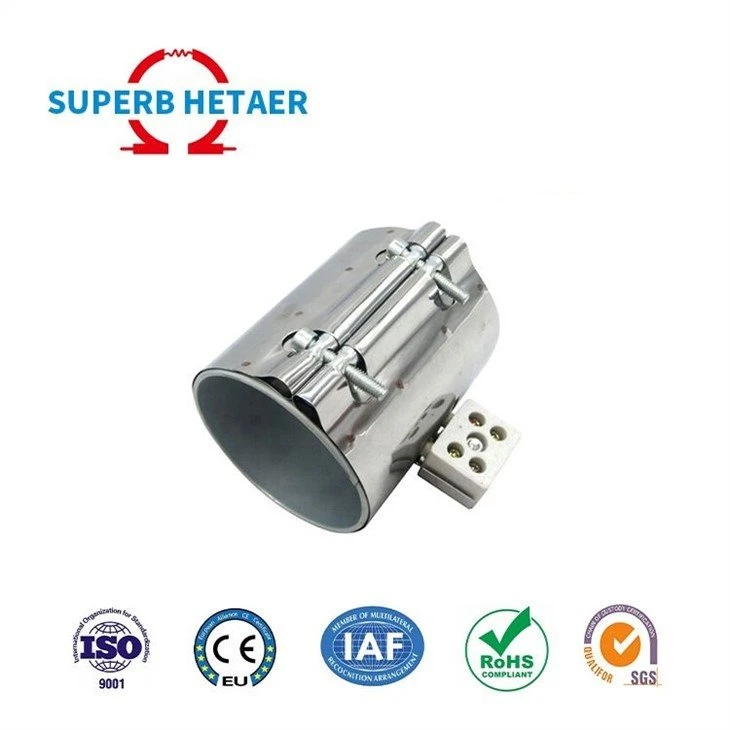
Professional industrial band heating element heater is constructed with a mica core wound with wire. The core is then bent into a circle band. Leads are attached before the final outer sheaths are attached to complete the heater. Our Mica Band heaters can be installed directly onto barrel heaters without the requirement of initial heater removal
Description
Product description
Professional industrial band heating element heater is constructed with a mica core wound with wire. The core is then bent into a circle band. Leads are attached before the final outer sheaths are attached to complete the heater. Our Mica Band heaters can be installed directly onto barrel heaters without the requirement of initial heater removal
These heaters consist of an etched foil element in between layers of flexible mica and operate at high temperatures with quick response times in industries ranging from military to semiconductor to food service. Mica heaters are custom designed to accommodate curved surfaces in many shapes and sizes.
Professional industrial band heating element heater is commonly used whenever heat is needed around the surface area of a pipe, tube or cylindrical vessel. They provide a fast-acting indirect heat that many industries, especially plastics, find perfect for their needs. There are three main types of band heaters: mica, ceramic and mineral-insulated.
Band heaters are ring-shaped heating devices that clamp around a cylindrical element. Heat transfer from band heaters occurs via the conductive method. Most band heaters clamp around the outer diameter of a cylindrical element and heat the element from the outside.
Advantages
1.The sheath of Low Cost Mica band heater is rust resistance.
2.High class Nickel Chrome ribbon is used.
3.Maximum power: 3w/cm2(s.steel),4.5w/cm2(brass),6.5w/cm2(ceramic insulation)
4.Operating temperature up maximum of 600 degree centigrade
5.Axial, Radial & Tangential terminals are available
6.Thermocouple holes can be provided as per client's requirements


Product Application
1.Injection Moulding / Extrusion Machines
2.Rubber Moulding /Plastic Process Machinery
3.Tooling & Die Heads
4.Packaging Machinery
5.Shoe Manufacturing Machinery
6.Test Equipment/Laboratory Equipment
7.Food Process Machinery
8.Drums containing solids or fluids
9.Vacuum Pumps and more...




FAQ
Q:Can we get some samples? Any charges?
Yes, free existing labels, you need to pay shipping cost.
Q:How can we get a quote?
Contact us with specification: such as material, design, size, shape, color, quantity, surface finishing, etc. Q:What's the trade term and payment term?
Amount less than $1000, 100% paid before production, more than $1000 can be negotiated!
T/T, Western Union, PAYPAL etc.
Q:How does a Thermolator work?
Molds are heated and maintained at a preset temperature using thermolators or temperature control devices that circulate coolant (water or oil) through the molds. Our temperature control equipment is made to work in the majority of industrial applications and has been proven to regulate process temperatures ranging from 20°F to 650°F.
Q:How are injection molds heated?
The injected material heats the injection mold in cycles. The heat is released by heat transfer to the circulating heat transfer medium from the surface of the temperature control channel, where it is dissipated by thermal conduction in the material and steel of the mold (water or oil).
Q:How do I choose a mold temperature controller?
The mold temperature controller can supply sufficient flow rate and pressure if the coordinate point is below the line. The mold temperature controller is unable to supply enough flow rate and pressure if the coordinate point is above the line.
Q:What are heater bands for injection molding?
In the plastics sector, mica band heaters are frequently used for blow molding, injection molding, and extrusion. In order to transform the contents from a solid state to a molten liquid, the heater is placed over cylindrical metal pipes or a barrel.
Send Inquiry
You Might Also Like


