

Leading manufacturer and supplier of high quality cartridge heaters
To get the best results when buying cartridge heating elements from a cartridge heating element supplier, Using our exclusive website previewer, you can rapidly learn about each cartridge heater element specialty. At the same time, As an excellent cartridge heater manufacturer, we can provide more.
We are confident that you will be more than happy with our cartridge heaters, which is why we offer a quality guarantee. If you are not 100% satisfied with your product, you can return them (as long as they are unused) within 7 days for a full refund. If you require something different to our standard range, why not give us a call? Specials can be made within a 2-3 week lead time.
For any other non-standard designs, we offer an efficient 3-week turnaround. This even applies to specialist design requirements, such as fitted temperature sensors or zone heating patterns.

01
Fast Deliveries
We endeavour to provide all our customers with a first-class, quality service as standard. All orders received within 7 days.
02
Quality Promise
Our goal is to provide the highest-quality cartridge heaters for all of our clients. We continuously strive to improve the performance of our cartridge heating elements and aim to surpass both your requirements and expectations. Whether you’re choosing from our standard stock or need a specialist part, we promise to provide the best possible product at the best possible price.
03
Stock On Hand
We carry over 200 different cartridge heating elements and stock a range of metric and imperial sizes as standard. These are all available for immediate dispatch, so your production line won’t be out of action for as long as you thought.



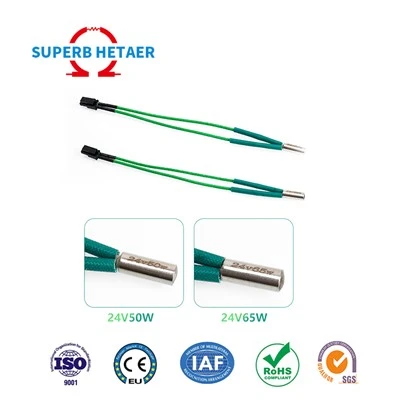

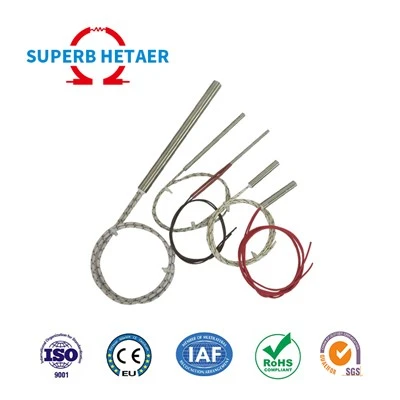
What are Cartridge Heating Elements
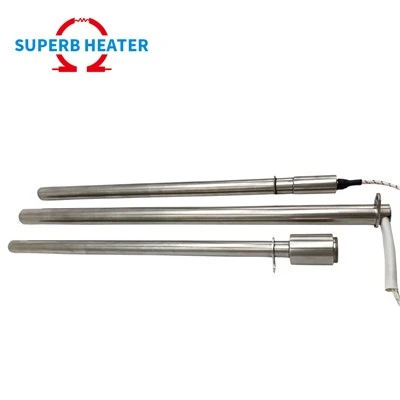
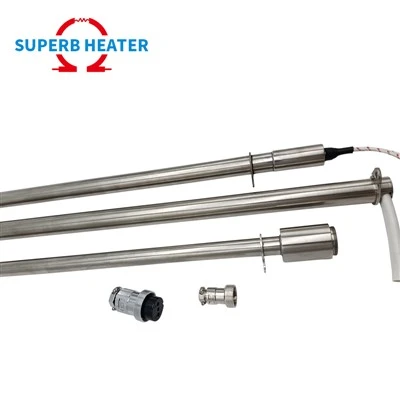
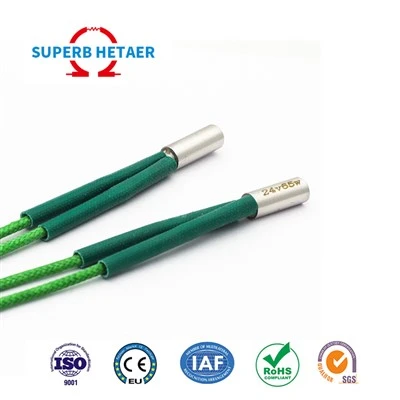
Cartridge heaters can be manufactured to a specific watt density based on the application's requirements and are commonly used to heat a metal block from the inside. Typically, cartridge heaters are put into drilled holes to heat metal items. The heaters are undersized in comparison to their nominal diameter, allowing for straightforward installation.

How Cartridge Heating Elements Work
A cartridge heater has a resistance coil wrapped around a ceramic core covered in a metal sheath and surrounded by a dielectric. The sheath warms up as a result of the heat transmitted by the coil.
This heat transmission is subsequently directed to the internal metal component in need of heat. In low or medium-temperature applications (600 °F [315.5 °C] or less), general-purpose drills are usually adequate for drilling holes for cartridge heater installation. Fits range from.009" to.014" when holes are drilled.003" to.008" larger than the drill's nominal size.
Even though the fit is slightly looser than ideal for optimal heat transfer, it facilitates the installation and removal of cartridge heaters, particularly those with long sheaths.

Design of Cartridge Heater Elements
These items typically consist of seven components: a heating coil, insulation, sealing, sheath, watt density, lead wire type, and termination. The metal sheath that surrounds the electric coil is coated with ceramic, mica, mineral, or fiberglass insulation.
The type of insulation used depends on the heater's intended wattage and application. Because contact between the heating coil and sheath can cause a short-circuit, insulation is an important component to highlight. Sheaths can be made from a variety of materials, including aluminum, copper, iron, nickel, and stainless steel.
Types of Cartridge Heater Elements
The different types of cartridge heater elements include

Swaged Cartridge Heater Elements
Before the swaging procedure, all of the heater's components—including the core, resistance wiring, and oxide powder—are added. By forcing the heater into a die, mechanical swaging constricts, shrinks, and compacts the heater's diameter and internal components. As a result, efficiency is increased, improving the heat transfer process.
Thermocouple Cartridge Heaters
Cartridge heaters with thermocouples heat the surface, and their wattage, density, and fit are calculated using intricate algorithms. They are beneficial in confined spaces because the internal thermocouple measures the temperature of the sheath.
The thermocouple's sensor and power wires are both located outside the sheath. Thermocouple cartridge heaters come in a wide variety and are made for various uses. The heater's interior or midsection can both receive the thermocouple.
Multizone Cartridge Heaters
Multi-zone cartridge heaters have two leads for each zone and a coil unique to each area of the heater. The zones may have a single common wire for one of the leads in some arrangements, enabling control of the various parts. Turning off a zone when it is not necessary reduces the amount of energy used, which is a benefit of the multi-zone system.
Miniature Cartridge Heaters
A small cartridge heater must have a length of no more than three inches (76.2 mm) and diameters of 0.125 in (3.175 mm), 0.156 in (3.97 mm), and 0.187 in (4.76 mm). Miniature cartridge heaters often have 304 or 316-grade stainless steel exteriors. The majority of small heaters are swaged for dielectric strength as well as resistance to shock and vibration.
Square Cartridge Heaters
Instead of a round diameter, square cartridge heaters feature a square or rectangular form. They can be swaged and compacted and have the same capabilities as round tubular cartridge heaters. They can be clamped into milled slots on a tool surface to provide efficient heating. Their distinct design allows easy removal for cleaning and maintenance.
Threaded Fittings
Threaded fittings guarantee a snug fit for the cartridge heater in the application, much like flanged fittings do. Fast removal and installation are made possible via threaded fittings. Moisture seals are typically applied for additional security.