


Analysis of the relationship between resistor operating temperature and power (3)
Leave a message
The differential equation for balancing the heat generated and consumed during the fixed experimental time is:
Where dt is the temperature rise during the fixed experimental time. Solving this equation yields:
Where: 
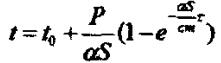
p is the DC continuous working power;
α is the heat dissipation coefficient, which is equal to the amount of heat dissipated from an area of 1 cm² per second at a temperature of 1°C, in watts/cm²°C;
S is the surface area of the resistor, in cm²;
t is the temperature of the resistor, in °C;
t. is the temperature of the surrounding medium (room temperature), in °C;
c is the specific heat capacity of the resistor, in (joules/grams°C);
m is the mass of the resistor, in grams;
The above formula shows that when the load is continuous and constant power is applied, the temperature t of the resistor increases exponentially with time τ, and the curve changes as shown in Figure 1. From the above formula and the figure, it can be seen that when the time tends to infinity, the temperature of the resistor reaches a certain stable value: 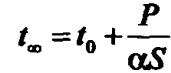
At this time, the heat generated by all the power is dissipated into the surrounding medium, and the temperature no longer rises. This state is called thermal equilibrium.


