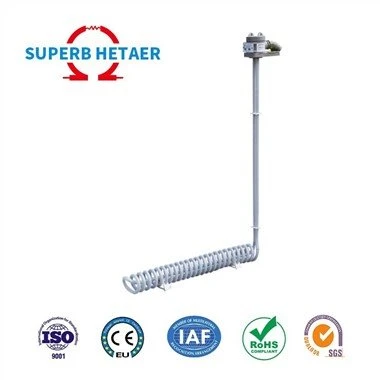
Cartridge vs. Band Heaters in Hot Runner Applications
Leave a message
In precision injection molding, consistent thermal management directly defines part quality, cycle efficiency, and operational stability. A frequent point of uncertainty in hot runner design centers on choosing between cartridge heaters and band heaters, two widely used forms of hot runner heater technology. Selecting the right type avoids uneven heating, temperature lag, material degradation, and unplanned downtime.
Cartridge heaters are cylindrical, insertable heating elements designed for internal mounting within drilled cavities or manifolds. They transfer heat through direct conductive contact with the surrounding metal, concentrating energy inward toward the melt channel. In practice, this structure delivers fast thermal response and high power density in compact spaces. Typical applications include internal hot runner nozzles, manifold cores, and small‑space zones requiring pinpoint, high‑intensity heat.
Band heaters wrap externally around cylindrical components such as nozzle bodies and barrel sections. They operate via surface contact, spreading heat evenly over the outer diameter to warm the wall thickness uniformly. This external layout creates consistent radial temperature distribution and simplifies installation, servicing, and replacement. Band configurations are widely used in standard external hot runner setups where broad, stable surface heating is preferred.
Key performance differences shape real‑world selection. Cartridge units offer faster heat penetration and tighter control for internal, high‑precision zones but depend on precise hole sizing and full contact for efficiency. Poor fit leads to hotspots and shortened service life. Band units provide broader, more uniform surface heating with easier access but involve slightly longer thermal lag and higher potential heat loss to the surrounding mold.
From field experience, long‑term reliability relies heavily on installation quality. Cartridge heaters need clean, properly sized bores with no gaps or debris to maintain consistent heat transfer. Band heaters require full, even contact with the outer surface; loose fitting or uneven tension creates cold spots and unstable temperature readings. Thermocouple positioning also plays a critical role-placement too close or too far from the heat source reduces control accuracy and can damage sensitive materials.
For general guidance, prioritize cartridge heaters for internal hot runner layouts, compact nozzle cores, high‑precision temperature zones, and applications with limited radial space. Choose band heaters for external heating setups, standard nozzle bodies, larger barrel sections, and scenarios calling for straightforward maintenance and uniform surface warming. Always match power density, voltage, and dimensions to the specific hot runner geometry and processing temperature window.
Thermal consistency in hot runner systems depends on matching heater type to mechanical design, material requirements, and production targets. Every mold and material combination benefits from tailored heating solutions that balance responsiveness, uniformity, efficiency, and durability. Specialized engineering support ensures the optimal hot runner heater configuration is selected for sustained performance and cost‑effective operation across high‑volume manufacturing environments.