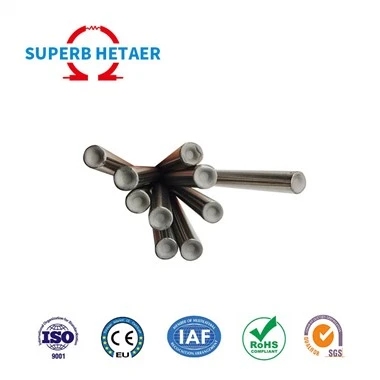
Choosing the right low-priced single-ended electric heating element and avoiding lightning strikes: A comprehensive overview of the key differences between good and bad quality.
Leave a message
Single-ended heating elements are widely used in mold heating and small equipment heating due to their compact structure and high heating efficiency. Many users tend to choose low-priced products to control costs, but the low-price market is rife with substandard products, and quality differences directly affect safety and lifespan. This article comprehensively analyzes the core differences between good and bad quality from four dimensions: core components, key performance, visual inspection, and selection matching, helping you avoid pitfalls and choose the product with the best cost performance.
I. Core Components: Materials and Manufacturing Processes Determine Basic Quality
The core components of a single-ended heating element include the heating wire, the tubing, and the insulating filler. The choice of materials and the manufacturing process are the root cause of quality differences and are also the areas where low-priced products are most likely to cut corners.
1. Heating Wire: The Core of Heating, Quality Directly Determines Lifespan
High-quality single-ended heating elements use high-purity iron-chromium-aluminum or nickel-chromium alloy heating wires. The alloy ratio is precise, with extremely low impurity content. It can stably withstand high-temperature oxidation and current surges. The wire diameter is uniform with strict tolerance control (typically ±0.01mm). After annealing and brightening, the surface is smooth, and the formed oxide film is uniform and dense. Long-term use results in a resistance change rate ≤0.5%, and strong power stability. This type of heating wire provides uniform heating and will not burn out due to localized excessive thinness, with a lifespan exceeding 5000 hours.
Low-priced, inferior products, in order to reduce costs, often use heating wires made from recycled materials. These wires have high impurity content, unbalanced alloy ratios, large wire diameter deviations, and rough surfaces, making the oxide film prone to peeling off. During use, the resistance fluctuates drastically with temperature, resulting in either insufficient power for slow heating or rapid burnout due to localized overheating, and may even trip due to short circuits. Their lifespan is often less than 1000 hours.
2. Piping: A Protective Barrier; Material Suitability is Key
High-quality products select appropriate piping materials based on the application scenario: 304 stainless steel (550℃ resistance) is used for heating air or neutral media; 321 stainless steel (700℃ resistance) is used for heating water or slightly corrosive media; and 316L stainless steel is selected for highly corrosive environments to ensure corrosion resistance and high-temperature resistance meet standards. The pipe wall thickness is uniform, free of sand holes and cracks, and the pipe ends are meticulously sealed using ceramic caps or high-temperature silicone sealant to eliminate the risk of breakage or carbonization. For single-ended quartz heating elements, dehydroxylated quartz tubes are selected to avoid tube bursting.
Low-priced, inferior piping often uses low-quality 201 stainless steel or recycled stainless steel, with thin and uneven wall thickness, prone to sand holes and cracks; some manufacturers even use ordinary iron sheet plated with nickel to imitate stainless steel, which will rust and corrode after short-term use. The sealing process is often rudimentary, involving simple encapsulation or manual sealing, which easily leads to slow air leakage. During heating, heat escapes, reducing efficiency and potentially causing the insulation layer to become damp and fail. If made of quartz, unde-hydroxylated quartz tubes are used directly, posing an extremely high risk of tube bursting.
3. Insulation Filler: Safety Guarantee, Insulation Performance Cannot Be Ignored
High-quality single-ended heating elements are filled with high-purity magnesium oxide powder, offering excellent insulation and thermal conductivity, effectively isolating the heating wire from the tube and preventing leakage. A high-pressure, dense filling process ensures no gaps, preventing insulation failure at high temperatures due to loosening. Cold-state insulation resistance is ≥50MΩ, and no flashover or breakdown occurs within 1 minute during withstand voltage testing.
Low-priced, inferior products often use low-purity magnesium oxide powder, or even impurities such as talc, resulting in poor insulation and loose filling. High temperatures during use can cause the filler to loosen, leading to a rapid drop in insulation resistance (below 2MΩ), posing a significant risk of leakage. Touching the tube may cause electric shock.
II. Key Performance: Parameter Compliance Directly Affects Safety and Efficiency
Besides core components, key performance parameters such as rated power deviation, heating rate, and insulation withstand voltage are crucial for judging quality and are often areas where low-priced products "falsely advertise" or "fail to meet standards."
1. Rated Power: False Advertising is a Common Tactic in Low-Priced Products
High-quality single-ended heating elements, under full heating conditions, have a rated power deviation strictly controlled within ±5%, and the actual heating effect is consistent with the labeled parameters. The theoretical resistance value can be calculated using the formula R=U²/P (e.g., a 220V/1000W heating element has a theoretical resistance of 48.4Ω). A deviation of ≤10% between the measured and theoretical values is considered合格 (qualified).
Low-priced products commonly suffer from falsely advertised power ratings. A product labeled 1000W may actually only have 600-700W, resulting in a significant decrease in heating efficiency. Some products attract customers by exceeding the advertised power, offering fast short-term heating, but long-term overload operation accelerates component aging and increases safety hazards. 1. If the resistance value during actual testing is significantly higher than the theoretical value (e.g., several hundred ohms), it indicates poor contact of the heating wire; a resistance close to 0Ω indicates a short circuit, both of which constitute defective products.
2. Heating and Heat Dissipation: Uniformity Determines User Experience
High-quality single-ended heating elements heat up quickly, reaching the test temperature from ambient temperature in ≤15 minutes under rated voltage, with uniform heating, turning red synchronously from the center outwards without localized overly bright or dark areas. For scenarios requiring precise temperature control, such as mold heating, segmented heating designs are also available, with each segment's power adapted to the temperature requirements, and a temperature uniformity error of ≤±1℃.
Inferior products heat up slowly, often exceeding 20 minutes without reaching the rated temperature, and exhibit uneven heating with localized overly bright "hot spots," easily leading to localized overheating and damage to the heated object; some products, due to unreasonable power density design, have excessively high surface power and lack effective heat dissipation structures, causing heat accumulation during use, accelerating insulation aging, and posing safety risks.
3. Insulation and Withstand Voltage: Safety Bottom Line, Not to be Exceeded
High-quality products have excellent insulation performance. Using a 500V megohmmeter, the insulation resistance between the lead rod and the outer casing of the tubing should be ≥100MΩ. After maintaining the specified test voltage for 1 minute, there should be no flashover or breakdown, and the leakage current should be ≤0.5mA, ensuring water and electricity separation and safe use.
Low-priced, inferior products have extremely poor insulation performance. Measured insulation resistance is often below 1MΩ, or even shows a clearly defined resistance value, posing a serious risk of leakage. Flashover is prone to occur during withstand voltage testing, which may trigger the leakage current circuit breaker to trip during use, potentially leading to electric shock in extreme cases.
III. Visual Inspection: 3 Simple Methods to Identify Quality on-site
No professional equipment is needed when purchasing. A preliminary judgment of quality can be made through visual inspection and simple tests, making it especially suitable for on-site procurement scenarios.
1. Visual Inspection: Details Reveal the Quality
High-quality products have a smooth surface free of dents, cracks, or burn marks; the tubing has a uniform color; the ceramic caps or silicone seals at the terminals are intact, without breakage or powdering; the lead-out rods (stainless steel rods) show no severe oxidation, deformation, or breakage; if there are threads, flanges, or other fittings, the welds are firm and not loose.
Inferior products have a rough surface, possibly with obvious scratches, pinholes, or rust; gaps and carbonization marks are easily found at the seals; the lead-out rods are severely oxidized, and weld points may even be visible; fittings are not firmly welded and feel loose with a slight shake.
2. Dry Burn Test: Visually Assessing Heating Uniformity (Performed in a Safe Environment)
Clean the surface of the heating element and, in a well-ventilated, fire-resistant environment, connect it to a 220V power supply while suspended in the air. Briefly power it on for 10-15 seconds and then disconnect the power. High-quality products should glow red evenly, without any areas that are too bright or dark; after cooling, wipe with a paper towel, and no black oxide powder residue should remain (indicating a dense oxide film and no excessive oxidation). Inferior products may rapidly glow red or even spark when powered on, accompanied by an unpleasant odor; wiping after cooling will leave a large amount of black oxide powder, indicating severe oxidation of the heating wire and a short lifespan.
3. Initial Multimeter Test: Eliminating Basic Faults
Set the multimeter to the resistance range (around 200Ω). Connect the two probes to the two leads of the heating element. A normal product will display a stable resistance value, with a deviation ≤10% from the theoretical calculation value; if it displays "1" or "OL" (overflow), the heating wire is burnt out; if the resistance value is close to 0Ω, it indicates an internal short circuit, both indicating inferior products.
Next, set the multimeter to the highest resistance range. Connect one probe to the lead and the other to the outer casing of the heating element. A high-quality product should display "1" or "OL" (infinite resistance); if it displays a specific resistance value, the insulation performance is degraded, posing a risk of leakage.
IV. Selection and Matching: Choose the Right One, Not the Most Expensive; Suitability for the Scenario is Key
Besides the quality of the product itself, whether the selected model matches the usage scenario directly affects the performance and lifespan. Many users neglect proper selection, leading to premature damage to even high-quality products, which they mistakenly attribute to quality issues.
1. Clarify Core Parameters: Avoid Incorrect Selection
Before purchasing, three core parameters must be clarified: First, voltage (commonly 220V or 380V; it must match the power supply environment to avoid using a 220V heating element on a 380V system, which could cause the element to burst); second, power (calculated based on the heating medium and requirements, referring to surface power density: no more than 10W/cm² for water heating, and no more than 5W/cm² for air heating); third, dimensions (the tube diameter and length must precisely match the mounting holes to avoid excessive gaps that could lead to heat loss or installation failure).
2. Adapt to the Usage Environment: Choosing the Right Material is Key
For heating water or in humid environments, choose 321 or 316L stainless steel to prevent rust and corrosion; for heating corrosive media, 316L or alloy materials must be used; for high-temperature environments (above 700℃), 310S stainless steel or carbon fiber quartz tubes must be used, as ordinary stainless steel will age and fail quickly. Low-priced products often use ordinary stainless steel indiscriminately, regardless of the application, making them highly susceptible to damage in special environments.
3. Focus on Detailed Design: Enhancing Usability
High-quality products are designed with details tailored to specific usage needs: For frequently moving molds requiring heating, internal lead wire technology is used (high-temperature wires are led out directly from the inside, reducing the risk of breakage); through-hole installations require limiting and fixing plates to prevent longitudinal displacement; high-temperature environments are equipped with high-temperature leads, and junction boxes are well-sealed. Low-priced products often feature standard, rudimentary designs without targeted optimization, making them prone to problems such as wire breakage and loosening in complex scenarios.
V. Summary of Tips for Avoiding Low Prices: 3 Core Principles for Choosing the Right Product
1. Avoid Extremely Low Prices: The core materials and processes of single-ended heating elements have fixed costs. Products priced significantly below the market average inevitably cut corners on heating wire, tubing, and insulation materials; avoid these.
2. Prioritize Verifying Parameters: Request product parameters from the seller (power, voltage, material, insulation resistance, etc.). If necessary, test the resistance value on-site with a multimeter to eliminate falsely labeled or faulty products.
3. Match to Scenario Needs: Select the right model based on the heating medium, temperature, and installation dimensions. Don't blindly pursue "high power." Material compatibility with the environment extends lifespan and avoids waste.
In short, the core of choosing a low-priced single-ended heating element is "identifying the material, checking performance, and selecting a suitable fit," avoiding the three major pitfalls of "material downgrades, falsely labeled parameters, and rudimentary processes." Even when choosing a low-priced product, accurate judgment will allow you to select a high-quality product that meets your needs, balancing cost and safety.