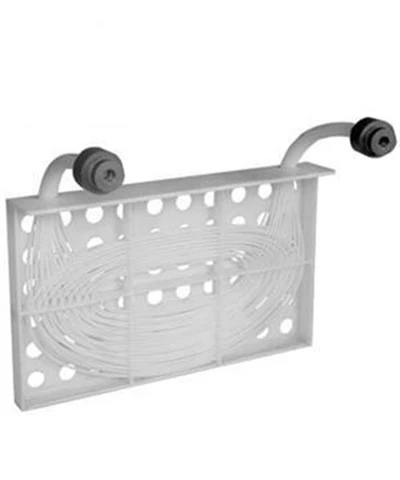
Do you know any heating methods for lithium battery heaters?
Leave a message
1. Resistance heating
Using the Joule effect of working current to convert electrical energy into thermal energy for heating larger objects. Silicon rubber heating plate heating element: Wrap nickel alloy heating wire around glass fiber, heating power can reach 2.1W/c ㎡, heating more evenly. Moisture and chemical resistant silicone rubber material provides a longer heater lifespan. Pressure sensitive adhesive can be used to bond flat and smooth workpieces. The oil drum heating belt adopts the soft and bendable characteristics of a silicone heating plate. Metal buckles are riveted on both sides of the heating plate with reserved holes, and spring buckles are used to fasten to the barrel, pipeline, and tank body. Easy and fast installation. It can make the silicone rubber heating plate use the tension of the spring to tightly adhere to the heated part, heating quickly and with high thermal efficiency. The heating element of a 3D printer is stacked layer by layer to create a 3D model. Its operation process is similar to that of a traditional printer, except that traditional printers print ink onto paper to form a two-dimensional flat drawing, while 3D printers use liquid photosensitive resin materials, molten plastic fibers, gypsum powder and other materials to achieve layer by layer stacking and forming a 3D solid through spraying adhesives or extrusion. Usually, it is mainly divided into direct influence of resistance heating by enterprises and indirect influence through resistance heating. The power system voltage of the former cannot be directly applied to the heated object. When there is current flowing, the information of the heated object itself (such as a silicone rubber heating belt ironing machine) will heat up. The object that can be directly heated by resistance must be a conductor, but it must have a higher electrical resistivity. Due to the fact that this heat is generated from the movement of the heated object itself, it needs to be heated internally, resulting in high thermal efficiency.
2. Induction heating
The thermal effect caused by the induced current (eddy current) generated by a conductor in an alternating electromagnetic field causes the conductor to generate heat. According to different heating process requirements, the frequency of AC power supply for induction heating is divided into power frequency (50-60Hz), medium frequency (60-10000Hz), and high frequency (above 10000Hz). Industrial frequency power supply is a commonly used power supply in industry. Most power sources in the world have a frequency of 50 hertz. The voltage added to the induction device by the industrial frequency power supply for induction heating must be adjustable. According to the power of the heating equipment and the capacity of the power supply network, high-voltage power sources (6-10kV) can be used to supply power through transformers, or the heating equipment can be directly connected to the 380V low-voltage power grid.
3. Arc heating
Heat objects under the high temperature generated by the arc. An arc is a gas discharge between two electrodes. The voltage of the arc is not high, but the current is large. Its strong current is maintained by a large number of ions evaporated from the electricity, so the arc is easily affected by the surrounding magnetic field. When an electric arc is formed between electrodes, the temperature of the arc column can reach 3000 to 6000K, making it suitable for high-temperature metal smelting.
4. Electron beam heating
Under the action of an electric field, high-speed electrons bombard the surface of an object, causing it to be heated. The main component of electron beam heating is the electron beam generator, also known as the electron gun. The electronic gun mainly consists of a cathode watch, a spotlight, a cathode watch, an electromagnetic lens, and a deflection coil. Yang is more grounded, and Yin is more connected to the negative high position. The focused beam is usually at the same potential as Yin, forming an accelerating electric field between Yin and Yang. The electrons emitted by the cathode are accelerated to a very high speed under the action of an accelerating electric field. They are focused by an electromagnetic lens and then controlled by a deflection coil, causing the electron beam to shoot towards the heated object in a certain direction.
5. Infrared heating
Utilize infrared objects to absorb infrared rays and convert them into thermal energy and heat. Due to the strong penetration ability of infrared radiation, it is easy to be absorbed by objects. Once absorbed by objects, it is immediately converted into heat energy. The energy loss before and after infrared heating is small, the temperature is easy to control, and the heating quality is high. Therefore, the application of infrared heating is rapidly developing.
6. Medium heating
Heat insulation materials with a high-frequency electric field. The main heating object is the dielectric. When a dielectric is placed in an alternating electric field, it will undergo repeated changes (under the action of an electric field, an equal amount of opposite charges appear on the surface or inside the dielectric), thereby converting the electrical energy in the electric field into thermal energy.