How to calculate the voltage at both ends of a thermocouple
Leave a message
What is a thermocouple?
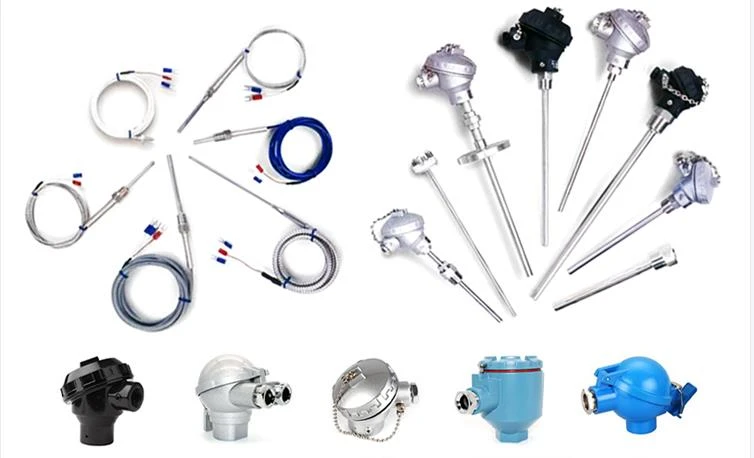
A thermocouple is a sensor for measuring temperature, consisting of wires of two different metals or alloys welded together. When there is a temperature difference between the two ends of the thermocouple, a voltage is generated, and this voltage can be used to calculate the temperature value.
What is the principle of a thermocouple?
The principle of thermocouples is based on the thermoelectric effect. The thermoelectric effect refers to the phenomenon of generating instantaneous electromotive force between two different metals or alloys. When there is a temperature difference between the two ends of the thermocouple, a current from high temperature to low temperature is formed between the two metals. The voltage generated by this current is the voltage of the thermocouple.
What is the calculation formula for thermocouple voltage?
The calculation formula for thermocouple voltage is u=Δ( α 1- α 2) DT, where u is the voltage, α 1 and α 2 represents the thermoelectric potential coefficients of two metals (different metals have different thermoelectric potential coefficients), and dT represents the temperature difference.
Is the voltage at both ends of the thermocouple proportional to the temperature difference?
Yes, the voltage at both ends of the thermocouple is directly proportional to the temperature difference. The larger the temperature difference, the greater the voltage generated by the thermocouple.
How to ensure the thermocouple?
The thermocouple depends on two aspects. Firstly, it is important to choose thermocouples with good quality and stable materials. Secondly, to calibrate the thermocouple, a standard temperature source is usually used to compare the thermocouple with a known temperature and adjust the calculated temperature value.
What are the application areas of thermocouples?
Thermocouples are widely used in industrial automation control, laboratory temperature measurement, aerospace and other fields. Due to its high sensitivity, good reliability, and wide measurement range, it is widely used in temperature measurement and control.