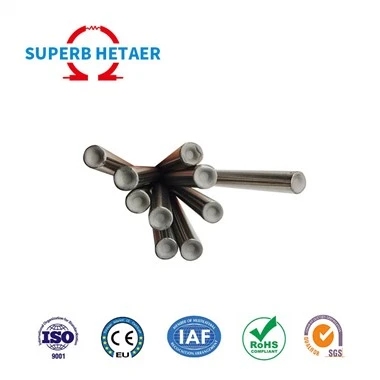
How to choose the lead out rod for electric heating wire, electric furnace wire, and resistance tape, and the precautions for use?
Leave a message
Electric furnace wires and resistance strips are commonly used as high-temperature heating elements in various high-temperature electric furnaces. Due to the high temperature during the operation of the electric heating wire, it is recommended to lead the electric furnace wire and resistance strip out of the furnace through structures such as lead out rods, whether from the perspective of insulation and sealing of the electric furnace or high-temperature protection of the lead out wire.
The lead out rod is made of high-temperature resistant alloy material that is straightened into a straight strip shape, and is slotted or perforated on one side for welding with the electric furnace wire, while the other side is threaded for wiring according to actual needs.
Common lead out rod materials:
SUS304 stainless steel: suitable for medium to high temperatures, with a bright appearance and low resistivity (0.73).
0Cr25AL5: High cost-effectiveness, high temperature resistance, and average antioxidant properties.
0Cr21AL6Nb: Compared to 0Cr25AL5, it has better high-temperature oxidation resistance.
310S stainless steel (Cr25Ni20): It is a high-temperature nickel chromium alloy with good oxidation resistance and high-temperature strength.
Precautions for using lead out rods:
1. Choose the appropriate material according to the actual temperature: if the furnace temperature is below 1000 ℃, it is recommended to use nickel chromium alloy lead rods. If the furnace temperature is above 1000 ℃, it is recommended to use iron chromium alloy lead rods.
2. Suitable diameter and length:
1) Select a suitable diameter lead out rod according to the cross-section of the electric furnace wire or resistance strip: Generally, it is recommended that the diameter of the lead out rod be greater than 3 times the diameter of the furnace wire. Common resistance rod diameters: φ 8mm φ 10mm φ 12mm φ 14mm φ 16mm φ 18mm φ 20mm, etc.
2) The lead out rod is not used for heating purposes, mainly for wiring purposes. Therefore, it is necessary to choose an appropriate length according to actual needs to prevent heat transfer from causing overheating of the lead part.
3. Welding between electric furnace wire and lead out rod: It is generally recommended to drill holes and mill grooves on the lead out rod, with the electric heating wire centered through the holes and firmly welded in the groove to avoid sparks and burns caused by unstable welding parts.
4. Connection between the lead out rod and the furnace body: The connection between the lead out rod and the furnace body must be sealed, firm, and insulated. The lead out rod should be placed in the middle of the insulation filler, and insulated and sealed with the furnace body using insulators and sealing fillers.