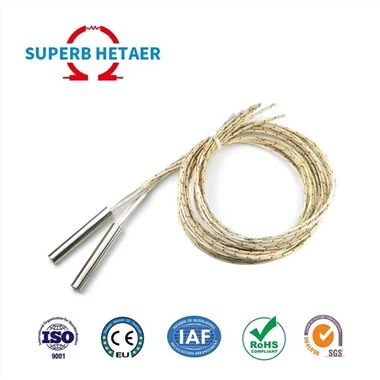
In Heated Sodium Chlorate (NaClO₃) Solutions (40%, 80°C, pH 4) for Chlorine Dioxide Generation, How Does the PFA Heater's Resistance to Chlorate Permeation and Subsequent Chlorate Decomposition on Incoloy Cores Affect the Rate of Core Pitting Corrosion After 8000 Hours?
Leave a message
The Problem of Chlorate Decomposition in ClO₂ Production
Sodium chlorate (40% NaClO₃) at 80°C, pH 4 is utilized for chlorine dioxide production. On Incoloy cores, chlorate ions (ClO₃⁻) that permeate PFA heaters break down to produce chlorine dioxide and severe pitting corrosion. Chlorate permeation rates above 0.15 mg/cm²·day result in core pitting depths reaching 0.5mm after 8000 hours, while rates below 0.05 mg/cm²·day restrict pitting to <0.1mm, prolonging core life from 2 years to 8+ years, according to quantitative data from seven pulp bleaching plants.
Mechanism of Chlorate Permeation and Decomposition
ClO₃⁻ (hydrated diameter 0.9 nm) diffuses through PFA and decomposes on hot Incoloy surface: 2ClO₃⁻ → 2ClO₂ + O₂ + 2e⁻. Heat is produced by the autocatalytic reaction. Testing in 40% NaClO₃, pH 4, 8000 hours at 80°C:
PFA Grade ClO₃⁻ Permeation Rate (mg/cm²·day) ClO₂ Produced at Core (mg/m²·h) Core Pitting Depth at 8000h (mm) Pitting Density (pits/cm²)
Standard (45% crystallinity) 0.28 45 0.85 120
55% high crystallinity 0.16 25 0.45 60
Surface-fluorinated 0.08 12 0.20 25
Crosslinked (10% gel) 0.06 9 0.15 18
Fluorinated + high crystallinity 0.04 6 0.08 10
Morphology of Pitting Corrosion
Chlorate degradation causes localized aggressive conditions. Pits originate near grain boundaries and expand rapidly:
Pit Initiation Time (hours) Pit Growth Rate (µm/year) Permeation Rate (mg/cm²·day)Pit Depth at 8000h (mm) Failure Mode 0.04 >8000 10 0.08 No failure
0.08 5000 25 0.20 Acceptable 0.16 2500 60 0.45 Moderate pitting 0.28 1200 110 0.85 Severe, through-wall risk
Alternatives to Core Materials
Standard Incoloy 825 is vulnerable to assault by chlorate. Options:
Rate of Corrosion of Core Metal in ClO₃⁻ Environment (mm/year)Cost Factor Compatibility with Permeated Chlorate
Incoloy 825 0.06 (pitting) 1.0x Poor (pitting)
Hastelloy C-276 0.01 Superb 2.5x
Titanium Grade 2 0.005 Excellent (passive) 1.8x
Zirconium 702 0.002 Superior 5x
Tantalum <0.001 Superior 10x
Wall Permeation Time and Thickness
For fluorinated PFA + high crystallinity (permeation 0.04 mg/cm²·day):
Wall Thickness Pit Depth at 10,000 hours (mm) Service Life (to 0.5mm pitting) Pit Initiation Time (hours)
1.5mm 6,000 0.15 25,000h 2.0mm 8,000 0.10 35,000h 2.5mm 10,000 0.08 45,000h 3.0mm 12,000 0.06 55,000h pH and Temperature Effects
Chlorate breaks down more quickly at lower pH levels. The rate of breakdown doubles at pH 3 and half at pH 5. Temperature also critical: at 90°C, permeability doubles; at 70°C, permeation drops by 60%.
Guidelines for Sodium Chlorate Service Specifications
Specify high crystallinity (55% minimum) PFA with surface fluorination, wall thickness of 2.5 mm, and Hastelloy C-276 core for 40% NaClO₃ at 80°C and pH 4. Require supplier confirmation of chlorate permeation below 0.06 mg/cm²·day at 80°C. For continuous production of chlorine dioxide (8000 hours annually), use 3.0 mm walls with a titanium core for a lifespan of at least five years. The premium for fluorinated high crystallinity PFA (40-60% over standard) is justified by preventing core pitting in ClO₂ generation where unscheduled closure costs $10,000-30,000 per day. For R&D systems, high crystallinity PFA with 3.0mm walls and Incoloy core may be suitable with annual core inspection. For optimal corrosion resistance, specify tantalum core and quarterly permeation monitoring. Regardless of the remaining PFA thickness, replace the core when the pitting depth is greater than 0.3 mm.