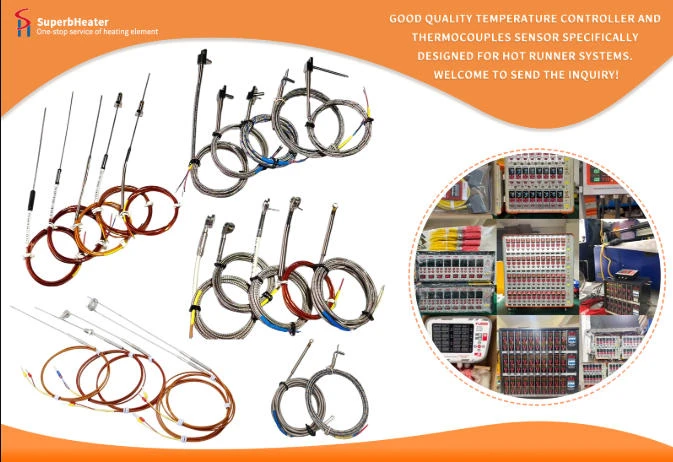
Installation and usage instructions for fixed-thread mounted probe-type thermocouples
Leave a message
Getting Ready for Installation
Choose K-type or E-type thermocouples that meet the specifications set by GB/T 16701 or IEC 60584. The material for the protective tube should be 316L stainless steel or alumina, and the threads should be M27×2 or 1″NPT, which is what most people use.
Opening the equipment: Use a machine to make an internal threaded hole in the pipe or equipment that fits the thermocouple thread. The thread depth should be at least 1.5 times the nominal thread diameter, and the threads should be clean and free of burrs.
Requirements for preheating: It is not allowed to put directly into high-temperature media.To avoid thermal stress that could make the protective tube break, the thermocouple must be carefully heated up to approach its operating temperature (for example, at a rate of 50°C/h) before it is installed.
Installation Operation Guidelines
1. Treatment for sealing
Wrap the threaded interface evenly with dust-free asbestos rope (temperature resistance ≥ 800°C) or fill it with high-temperature refractory clay to make sure there are no gaps and to stop hot media from leaking and errors from convection.
You can't use regular PTFE tape or adhesive since they will burn and break down at high temperatures.
2. Control of Tightening Torque
Use a torque wrench to put the thermocouple in place. Suggested range of torque:
M27×2: 40 to 60 N·m
M33×2: 60–80 N·m
Going over the higher limit could cause the protective tube to bend or the thread to strip, while going below the lower limit will make the seal weak.
3. How deep to insert
To make sure that the hot end is in full contact with the medium, the measuring end should be inserted at least 10 to 15 times the outside diameter of the protective tube.
The minimum insertion depth should be at least 75mm for high-pressure steam or fast-moving fluids.
4. Where to put it
Vertical placement is best; horizontal or slanted installation should be avoided since it could cause the protective tube to sag and change shape.
More support should be added while things are vibrating. Bracket that can handle vibrations to keep from breaking from long-term use.
Wiring and Cold Junction Compensation:
Polarity connection: The red wire is negative (-), the yellow wire is positive (+), and it is completely forbidden to connect them the other way around.
Use K-type matching compensation wires that reach the control cabinet's constant temperature zone (≤100℃). Then, turn on the instrument's automated cold junction compensation feature.
To stop moisture from building up and terminals from rusting, the wiring box outlet hole should be mounted facing down.
Verification After Installation
Temperature stability test: After the equipment reaches the operating temperature, check to see if the instrument reading stabilizes within 10 minutes. Changes of less than or equal to 1°C are fine.
Comparison method calibration (recommended):
Put both the thermocouple that needs to be calibrated and an S-type reference thermocouple into the constant temperature zone of a tubular calibration furnace at the same time (±0.2℃/min stability);
Record the thermoelectric potential at the target temperature points (e.g., 300℃, 600℃, 900℃), repeating the reading ≥4 times;
Find the average value and check it against the calibration table. The error should be less than or equal to ±1.5°C (K-type Class III tolerance).
Check the cold junction compensation: When the temperature outside changes (for example, from 15°C to 30°C), watch to see if the output is automatically corrected. If it doesn't wander, everything is working normally.
Limitations on Use
Do not put it directly into a medium that is hotter than 500 degrees Celsius without first heating it up.
You can't tighten it by hand; you need to use a torque wrench.
Don't utilize extension wires that don't match or aren't insulated.
Do not use the thermocouple as a load-bearing component or strike the protective tube.
The fixed-thread thermocouple is built to be strong, seal well, and be very reliable. It can work for a long time in boilers, reactors, steam pipes, and other places. If installed correctly, it can last for 3 to 5 years, making it one of the most cost-effective and stable ways to set up industrial temperature measurement systems.