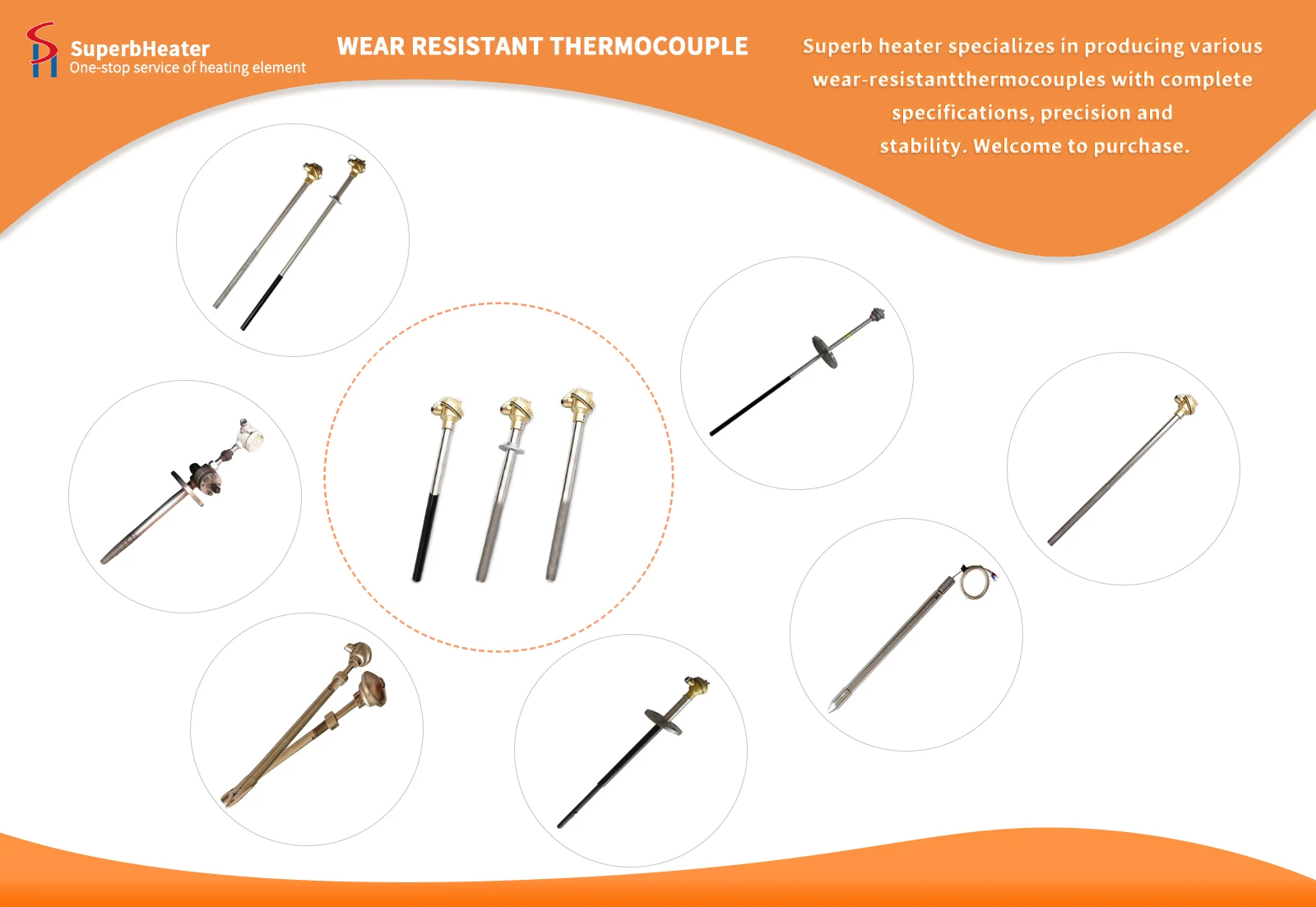
Introduction of Zirconia Probe Thermocouple
Leave a message
Thermocouples belong to contact-type temperature measurement in temperature measurement, which is used to measure the temperature of an object. First of all, thermocouples are the most widely used temperature devices in temperature measurement. Their main features are wide temperature measurement range, relatively stable performance, simple structure, good static response, and the ability to transmit 4-20mA electrical signals remotely, which is convenient for automatic control and centralized control. The temperature measurement principle of thermocouples is based on the thermoelectric effect. When two different conductors or semiconductors are connected into a closed loop, when the temperatures at the two contacts are different, a thermoelectric potential will be generated in the loop. This phenomenon is called the thermoelectric effect, also known as the Seebeck effect.
The thermoelectric potential generated in a closed loop consists of two potentials: temperature difference potential and contact potential. Thermoelectric potential refers to the potential generated by the temperature difference at both ends of the same conductor. Different conductors have different electron densities, so the potential they generate is also different; and the contact potential, as the name implies, refers to the potential formed when two different conductors come into contact and a certain electron dispersion is generated due to their different electron densities when they reach a certain equilibrium. The size of the contact potential depends on the material properties of the two different conductors and the temperature of their contact points. There is a standard for the thermocouples currently used in the world, which stipulates that thermocouples are divided into eight different divisions, namely B, R, S, K, N, E, J and T. The lowest temperature can be measured is minus 270 degrees Celsius and the highest can reach 1800 degrees Celsius. Among them, B, R, and S belong to the platinum series of thermocouples. Because platinum is a precious metal, they are also called precious metal thermocouples. The remaining ones are called cheap metal thermocouples.
There are two structures of thermocouples, ordinary type and armored type. General thermocouples are generally composed of thermocouples, insulating tubes, protective sleeves and junction boxes, while armored thermocouples are assembled by assembling thermocouple wires, insulating materials and metal protective sleeves, and then stretched to form a solid combination. However, the electrical signal of the thermocouple requires a special wire to transmit, which we call a compensating wire. Different thermocouples require different compensating wires, and their main function is to connect with the thermocouple so that the reference end of the thermocouple is separated from the power supply, so that the reference end temperature is stable.
Compensating wires are divided into compensating and extended types. The chemical composition of the extended wire is the same as that of the compensated thermocouple. However, in reality, the extended wire is not made of the same metal as the thermocouple. It is generally replaced by a wire with the same electron density as the thermocouple. The connection between the compensating wire and the thermocouple is generally very clear. The positive pole of the thermocouple is connected to the white wire of the compensating wire, and the negative pole is connected to the remaining color. Most of the general compensation wires are made of copper-nickel alloy.