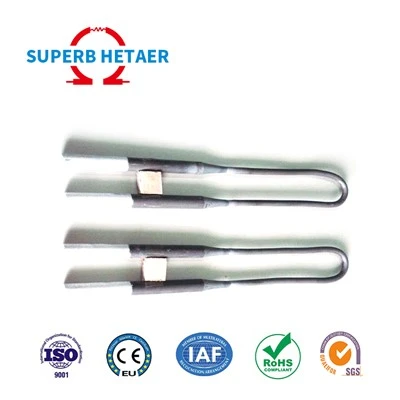
Performance and characteristics of quartz radiating tubular electric heating elements
Leave a message
Performance and characteristics of quartz radiating tubular electric heating elements
① High radiation efficiency. The spectral emissivity of quartz radiation tube shaped electric heating elements is as high as 90% -92%, and their radiation efficiency is as high as 90%, while the radiation efficiency of other radiation electric heating elements is generally only 62% -80%.
② Good safety performance. Quartz has an extremely low coefficient of linear expansion and excellent resistance to rapid heating and cooling, but there is no risk of rupture. At the same time, quartz has good electrical insulation performance and non hygroscopicity at high temperatures, so it can work safely and reliably in humid environments.
③ Low heat resistance, fast startup speed, and less residual heat after power outage.
④ Lightweight. Quartz radiation tube shaped heating element is 1/3 to 1/7 of the weight of metal tube shaped heating element and silicon carbide element.
⑤ Long service life.
1. Arc heating
(1) Using the electric arc between the electrode and the furnace material to directly melt the furnace material, such as an electric arc steelmaking furnace;
(2) Using the arc between electrodes to indirectly melt furnace materials, such as steelmaking arc furnaces;
(3) Utilizing the thermal energy converted by resistance and arc to comprehensively melt furnace materials, such as submerged arc furnaces.
2. Induction heating
Heating is carried out by the eddy current loss or hysteresis loss generated inside a conductor placed in an alternating magnetic field. It is divided into two types based on structure: with a core and without a core, and three types based on frequency: power frequency, medium frequency, and high frequency.
3. Medium heating
Heating by utilizing the loss of dielectric in an alternating electric field.
4. Resistance heating
(1) Electrify the heated object and directly heat it using the heat generated by the Joule effect;
(2) Heat indirectly heats objects through radiation, conduction, convection, or reflection.
5. Infrared heating
Utilize 300; 30000092 radio waves heat non-conductive materials.
6. Electron beam heating
Using electron beams to bombard objects in vacuum for heating.
Www.superbheater.com