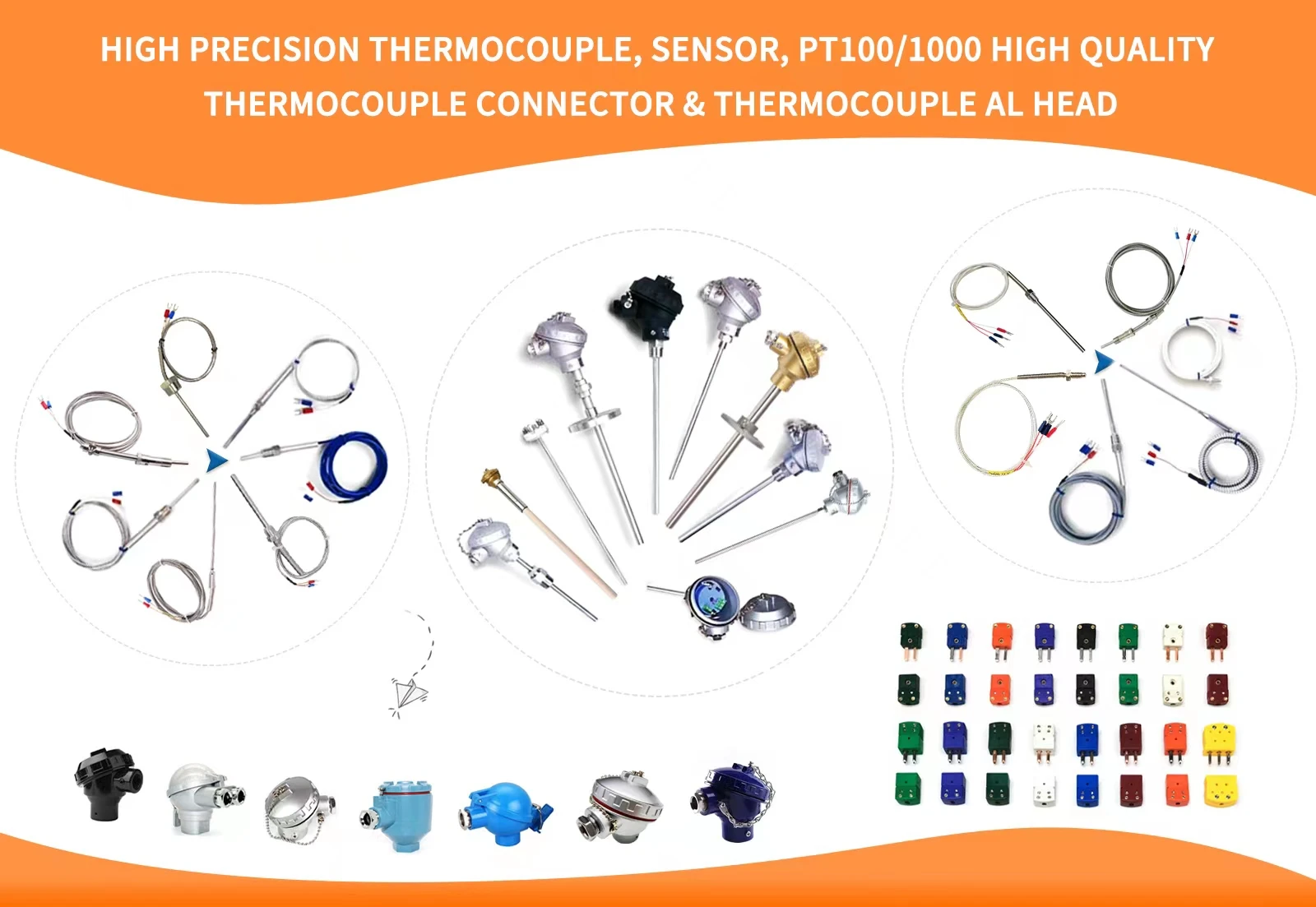
Right-Angle Thermocouples: Optimized Design for Effective Thermal Monitoring
Leave a message
Right-angle thermocouples are a useful instrument with an optimised design that provides special benefits for a variety of applications in the field of temperature measurement and thermal monitoring.
The characteristic angular bend of right-angle thermocouples distinguishes them from conventional straight thermocouples. This design element was thoughtfully created to satisfy certain requirements in a range of procedures and industries.
Two wires composed of different metals, such as chromel and alumel for K-type thermocouples, are often used in the manufacture of right-angle thermocouples. The sensing junction is created by joining these wires at one end. After that, the thermocouple is enclosed in a protective sheath, which may be composed of ceramic or stainless steel, depending on the needs of the application.
The ability of right-angle thermocouples to reach difficult-to-reach places is one of its main benefits. Straight thermocouples would not be practicable in many industrial situations due to complicated geometries or locations with restricted clearance. These spaces may be filled with right-angle thermocouples, which can be placed exactly where temperature monitoring is required. Right-angle thermocouples, for instance, may offer precise temperature readings in equipment with small compartments or in a pipeline with limited access without affecting the nearby components.
The right-angle design's flexibility also facilitates installation. Right-angle thermocouples may be tilted to reach the appropriate measurement point, in contrast to straight thermocouples, which could need intricate mounting configurations or adjustments to fit into certain places. This lowers the possibility of harming the thermocouple or the nearby equipment in addition to saving time and effort during installation. Right-angle thermocouples are simple to include into the production line of a manufacturing facility with complex equipment configurations without interfering with the sensitive assembly process.
The precision of right-angle thermocouples is another crucial feature. To guarantee steady and precise temperature monitoring, the materials utilised in their construction are carefully chosen. The protective shell does not impede the temperature sensing process, and the thermocouple wires have well specified thermoelectric characteristics. As a consequence, precise temperature measurements that are reliable for process monitoring and control are produced. Right-angle thermocouples may provide accurate temperature readings to guarantee that the chemical reactions take place within the intended temperature range in a chemical processing facility where exact temperature control is crucial for the quality of the final product.
Another important benefit of right-angle thermocouples is their durability. They are made to resist a variety of challenging conditions, such as high temperatures, corrosive materials, and mechanical strain. By acting as a barrier against these elements, the protective sheath guarantees that the thermocouple will continue to work even under trying circumstances. For example, right-angle thermocouples may be used in conveyor belts or crushers to monitor temperature and avoid overheating in mining operations where dust, moisture, and heavy gear are frequent. These thermocouples' longevity minimises downtime and the need for frequent replacements.
Right-angle thermocouples do have some drawbacks, however. The higher manufacturing and calibration complexity in comparison to straight thermocouples is one possible disadvantage. To guarantee precise temperature readings, the thermocouple's angular bend may introduce extra variables that must be taken into account during production. Additionally, because of their distinctive design, right-angle thermocouples may need to be calibrated using specific tools and techniques. The time and expense needed for manufacture and calibration may rise as a result.
The bending configuration's potential for signal interference presents another difficulty. The accuracy of the temperature readings may be impacted in certain applications by the angled part of the thermocouple being more vulnerable to magnetic or electrical interference. To reduce this interference and guarantee accurate results, careful shielding and grounding may be required.
To sum up, thermocouples with a straight angle provide an ideal design for efficient temperature monitoring. They are a vital tool in many different sectors and applications because of their precision, durability, simplicity of installation, and capacity to reach difficult-to-reach places. Their advantages often exceed their disadvantages, even if they do have some restrictions in terms of manufacturing complexity and possible signal interference. Right-angle thermocouples are anticipated to become increasingly more sophisticated and extensively used in applications where precise temperature monitoring in confined places is essential as technology develops.