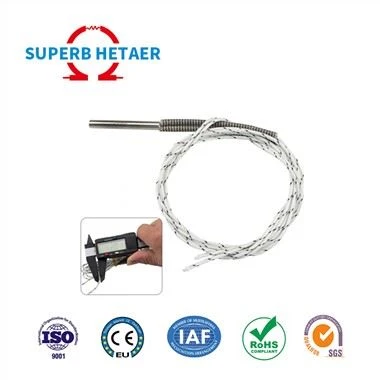
Stainless Steel Cartridge Heaters
Leave a message
Stainless steel cartridge heaters are simple tubular electric heating parts that have a strong stainless steel sheath around them. The device works by resistive heating (Joule heating), which turns electrical energy into thermal energy when current travels through the coiled wire. The MgO then transfers this heat, which is then evenly spread out into the target application through the stainless steel sheath. This MgO does two important things: it keeps electricity from flowing and it lets heat flow. The device works by resistive heating (Joule heating), which turns electrical energy into thermal energy when current travels through the coiled wire. The MgO then transfers this heat, and the stainless steel sheath evenly spreads it out into the targeted application. They are utilized in a lot of industries for heating liquids, air, and gas, controlling mold temperature precisely, drying ovens, packaging machinery, and many more process heating applications since they are strong, efficient, and adaptable.
Materials and Construction of the Core
The sheath material is very important since it affects how long the heater will last and what it can be used for. Some common grades are:
AISI 304 Stainless Steel is the industry standard because it is very resistant to corrosion in general, can be shaped into many different shapes, and is inexpensive for most uses that involve water, lubricants, and non-corrosive environments.
AISI 321 Stainless Steel is like 304 but has titanium added to it to make it more resistant to intergranular corrosion and better for long-term use at high temperatures (typically above 400°C).
AISI 316/L Stainless Steel: This grade is exceptionally resistant to pitting and crevice corrosion, especially in weak acid or chloride conditions, thanks to the presence of molybdenum. For many chemical and marine uses, it is the best material.
AISI 310S Stainless Steel is an austenitic alloy containing a lot of chromium and nickel. It can handle very high temperatures (up to 1150°C) and is very resistant to oxidation and carburization, which makes it perfect for use in furnaces.
The internal heating wire is usually made of iron-chromium-aluminum (FeCrAl) or nickel-chromium (NiCr) alloy. The type of wire is chosen depending on the desired working temperature, resistance stability, and cost. The high-purity, electrofused magnesium oxide filler is carefully processed to get the best dielectric strength and thermal conductivity.
Important technical specs and performance
To make the right choice and keep things safe, you need to know these parameters.
Rated Voltage and Power: The standard voltages are 120V, 240V, 380V, and 480V. To avoid the heater breaking down too soon, the power rating (wattage) must be carefully matched to the heater's surface area and the application's ability to get rid of heat.
The most essential design factor is surface load (watt density), which is measured in watts per square inch (W/in²) or watts per square centimeter (W/cm²). In most cases, stainless steel cartridge heaters make between 5 and 15 W/cm² (30 and 100 W/in²). When you put too much weight on something, the sheath gets too hot and the item doesn't last as long.
Rated Voltage and Power: The standard voltages are 120V, 240V, 380V, and 480V. To avoid the heater breaking down too soon, its power rating (wattage) must be the right amount for its surface area and the heat dissipation ability of the application.
The most critical design factor is surface load (watt density). It is measured in watts per square inch (W/in²) or watts per square centimeter. Most standard stainless steel cartridge heaters put out between 5 and 15 W/cm² (30 and 100 W/in²) of electricity. When you put too much weight on something, the sheath gets too hot and doesn't last as long.
Direct contact between the heating wire, high-density MgO, and metal sheath allows for good heat transmission with less internal thermal lag, which leads to fast heating cycles.
Strong Mechanical Strength and Easy Installation: The strong stainless steel sheath can handle physical stress and is easy to mill, weld, or add threads, flanges, or other fittings for easy and secure integration into equipment.
Great Value: Stainless steel heaters are a very reliable and cost-effective choice for most industrial and commercial heating needs. They are widely available and inexpensive compared to specialist sheaths like titanium, Inconel®, or Teflon®.
Important limits and safety measures for operations
In order to keep things safe and last as long as possible, the following rules must be observed.
Chloride Stress Corrosion and High-Temperature Degradation: Being above 500°C for a long time could speed up oxidation and scaling. Conventional 304/316 stainless steels are more likely to crack under stress in settings with chloride (even in small amounts from water or the air) at temperatures between 60°C and 200°C. The specific working environment must be taken into account when choosing materials.
Fouling and Scaling in Hard Water/Liquids: When you heat hard water or process fluids, the mineral scale on the sheath acts as a thermal insulator. This makes the internal heating wire work at a higher temperature to provide the same output, which causes localized overheating, wire failure, and worse efficiency. You need to regularly descale or pretreat the media.
The most common reason for a cartridge heater to fail right away is using it outside of its recommended heat-dissipating medium (air, liquid, or solid). Fouling and Scaling in Hard Water/Liquids: Mineral scale on the sheath functions as a thermal insulator when hard water or process fluids are heated. This makes the internal heating wire work at a higher temperature to provide the same output, which causes localized overheating, wire failure, and worse efficiency. You need to clean or treat the medium on a regular basis.
The most typical reason a cartridge heater stops working suddenly is when it is used in a heat-dissipating media that it wasn't made for (such air, liquid, or solid).
In conclusion, stainless steel cartridge heaters are a flexible and affordable way to heat things. Their performance and lifespan depend on choosing the right materials, following surface load guidelines, and avoiding operational hazards like dry-firing and being in corrosive environments that aren't compatible with them.