The Influence of Mold Preheating Speed on Thermocouple Service Life
Leave a message
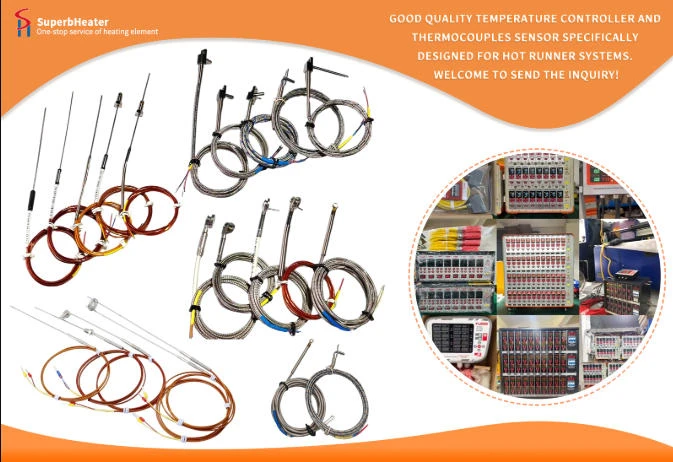
Spring-type thermocouples are a special kind of elastic contact temperature sensor designed for hot runners because of its integrated elastic compression architecture. They are widely used in easily mobile temperature measuring locations and nozzle heating sleeves.
Its most noteworthy feature is the incorporated spring compression design. After installation, it can rely on elastic force to keep the probe's tight pressure against the measured surface constant. Even under protracted high-temperature thermal deformation and equipment vibration, it can automatically compensate for assembly gaps and reliably maintain an extraordinary close contact state, fully resolving temperature lag and deviation caused by loose contact.
For spring-type products, there are no strict assembly depth tolerance requirements, which facilitates installation. Their high fault tolerance rate, low assembly complexity, and automatic compression stroke change during installation make them perfect for molds with slightly varying reserved hole positions.
In practical application situations, they are usually paired with split combined manifolds, hot runner nozzle heating sleeves, and frequently disassembled mold structures. They are able to sustain constant temperature measurement accuracy in high-vibration industrial environments. However, due of their complex internal elastic structure, these thermocouples are less resilient at high temperatures than solid integrated versions. Additionally, the elastic components rapidly lose their elasticity during extended high-temperature baking, reducing the compression effect.
Therefore, spring-type thermocouples are used in situations requiring automated gap compensation, whereas solid fixed thermocouples are still more reliable for long-term steady high-temperature operating settings.