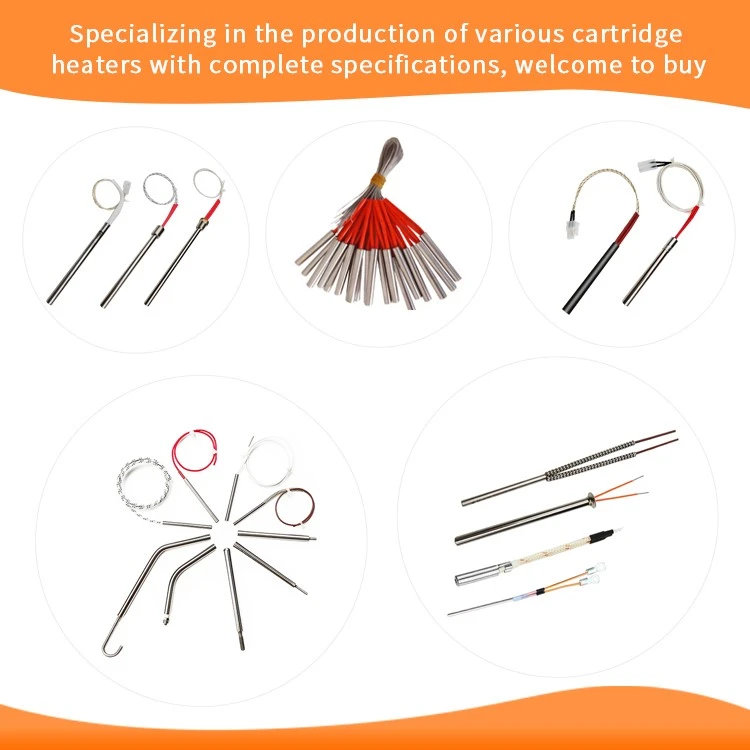
The Lead Wire Dilemma in cartridge heater
Leave a message
When people talk about heating technology, they often only talk about the heating coil inside the tube. But the lead wire is another important part that is often missed. The performance, safety, and lifespan of a standard 220V cartridge heater are all reliant on how well it connects to the power supply. Not paying attention to lead wire specifications is a typical mistake that can cause early failure, safety risks, and unplanned downtime.
The Foundation: Electrical and Thermal Sizing
The lead wires are the heating system's arteries. They carry the whole electrical current needed to create heat. Using wire that is too small for a 220V cartridge heater is a big mistake. A lead that is too small has more electrical resistance, which makes it overheat while it is under load. This can damage the insulation, make a fire risk, and even cause the voltage at the heater terminals to drop, which will lower its effective power output. Choosing the right wire gauge depending on the heater's amperage draw and the length of the run is a must for both safety and performance.
Insulation Material: Making Sure It Fits the Environment
The sort of insulation needed depends on the environment in which it will be used. Most industrial heating uses don't work with standard PVC-insulated wires. The machine's ambient heat and the heater's own radiant heat can quickly raise the temperature of PVC above its limitations, causing it to melt, break, or become brittle. This can lead to shorts or ground faults.
For places like ovens, plastic processing machines, or places where there are hot surfaces, high-temperature insulation is a must. Fiberglass, silicone rubber, and PTFE (Teflon) are some of the materials employed. They can handle being exposed to temperatures between 200°C and 250°C for long periods of time without breaking down.
Harsh Chemical Environments: If there are oils, solvents, or corrosive vapors in the area, the insulation must also be able to resist chemicals. PTFE and certain cross-linked polymers are great at protecting against a wide range of chemicals.
Durability in terms of mechanics: being able to handle stress and movement
The physical stress on the lead wire is just as essential as the electrical stress.
Flexing and Vibration: In applications with moving elements, like a packing machine's sealing jaw or a revolving drum, the wires are always bending. When you bend standard wire again and over, the fine copper strands get tired and break. This is called work-hardening. For these uses, you need cable that is specifically made to have continuous flex or have a high strand count. This cable has several thin strands of wire that are often protected by a special jacket compound. It can handle millions of flex cycles.
Connection Integrity: The place where the lead wire connects to the heater's internal terminal pin is a very important site of failure. A crimp connection that is not very strong can come loose when the temperature changes or when it vibrates. Welded or brazed connections between the lead and the terminal pin are a sign of a better cartridge heater. This makes a joint that is strong, low-resistance, and permanent, and it can handle tough industrial settings much better than just crimping.
The last step is installation and routing.
If you don't install a lead wire correctly, it can still fail, even if it is completely defined. It's very important to manage leads correctly:
Strain Relief: You need to use a clamp or cable tie to hold the wires in place within a few inches of the heater body. This stops any pushing, twisting, or vibration from going straight to the internal connection.
Avoiding Abuse: Leads should not touch sharp edges, pinch points, or surfaces that are hotter than the wire's temperature rating. In high-risk regions, it's best to use protective sleeving, conduits, or cable carriers.
Conclusion: The Important Link
The lead wire is the most important connection between the heating element and the control system. Choosing the right wire-with the right gauge, insulation that can handle high temperatures and chemicals, and a mechanical structure that fits the motion profile-is just as important as choosing the heater's watt density or sheath material. A truly strong heating system needs to look at the whole system, making sure that every part, from the terminal block to the tip of the heater, is designed to meet the needs of the job. Ignoring the lead wire is a recipe for failure that could have been avoided.