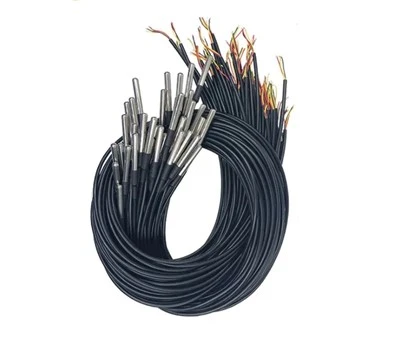
Two homogeneous conductors with different compositions of thermocouples are thermoelectric electrodes
Leave a message
Two homogeneous conductors with different compositions of thermocouples are thermoelectric electrodes
The basic principle of temperature measurement is that two different materials of conductors (called thermocouple wires or thermoelectric electrodes) form a closed circuit. When the temperature at both ends of the junction is different and there is a temperature gradient, there will be current passing through the circuit. At this time, there is an electromotive force between the two ends - thermoelectric electromotive force, which is called the Seebeck effect. Two homogeneous conductors with different compositions are thermoelectric electrodes, with the higher temperature end being the working end (also known as the measurement end) and the lower temperature end being the free end (also known as the compensation end). The free end is usually at a constant temperature. According to the functional relationship between thermoelectric electromotive force and temperature, create a thermocouple calibration table; The graduation table is obtained under the condition of a free end temperature of 0 ℃, and different thermocouples have different graduation tables.
Electric heating wire is a type of electrical component that generates heat when powered on, used to heat other items to be heated. Resistance, in fact, is the abbreviation of resistor. Strictly speaking, resistance is not something, but a parameter that describes the magnitude of the resistance of an object to current. The mathematical relationship is the ratio of voltage to current on the same electrical device, or the dynamic rate of change: dV/dI. Any object has resistance, in special cases, resistance can be zero or approximately zero, and in more special cases, resistance can be negative! When a resistor passes through a current, it theoretically generates heat, which is known as an electric heating wire. However, resistors in a circuit usually do not want it to generate heat. In this case, resistors with higher power tolerance are used. In low-power signal circuits, the heat generated by resistors can be almost negligible, such as the bias resistance of transistors, voltage of 5V, and current of 20 μ A. The power is only 0.1 milliwatts, and it is believed that even ordinary instruments cannot measure temperature rise.
Finally, make a sentence and give an example to illustrate the difference between the two:
The resistance of heating wire A during normal operation is 96.8 Ω. Connecting it to a 220V power supply will result in a power of 500W.
The current passing through resistor B exceeds the rated value too much, causing heat and excessive temperature rise. It's like an electric heating wire!
Www.superbheater.com