Type Of Heating Element
Leave a message
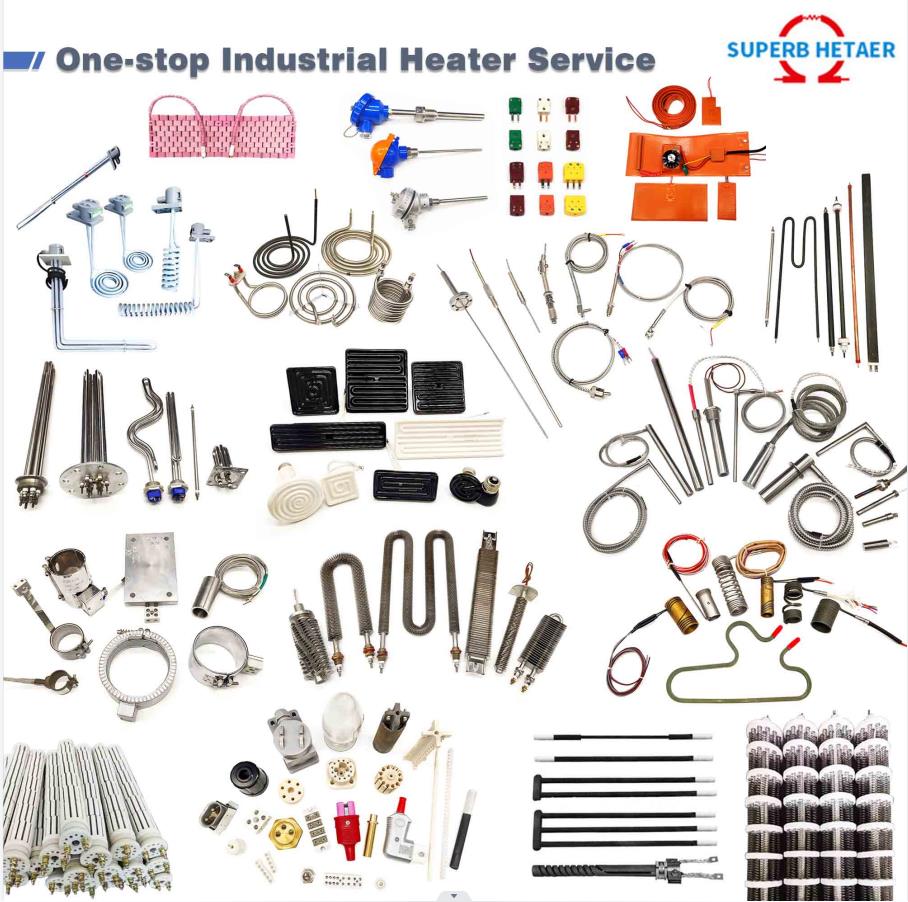
Individual heating elements do not include the entire heating system. In addition to the heating element, a heater includes terminals, leads, insulation, packing, jacketing, and seals. These heaters come in various forms and configurations to suit specific applications. The following are the types of heating elements:
1.Air process heater: As the name suggests, this type of heater is used to heat moving air. An air handling heater is basically a heated tube or pipe with one end used to bring in cold air and the other end as a hot air outlet. Along the pipe walls are heating element coils insulated by ceramic and non-conductive gaskets. These are typically used in high flow, low pressure applications. Applications for air handling heaters include heat shrink, lamination, adhesive activation or curing, drying, baking, and more.
2.Cartridge Heater: In this type of heater, resistance wire is wrapped around a ceramic core, usually made of compacted magnesium oxide. A rectangular configuration is also available, in which a coil of resistive wire passes three to five times along the length of the cartridge. Resistance wires or heating elements are located near the walls of the sheathing material for maximum heat transfer. To protect internal components, sheaths are often made of corrosion-resistant materials such as stainless steel. The leads are usually flexible and their two terminals are located at one end of the cartridge. Cartridge heaters are used for mold heating, fluid heating (immersion heaters) and surface heating.
3.Tube Heater: The internal structure of a tube heater is the same as that of a cartridge heater. The main difference from a cartridge heater is that the lead terminals are located at both ends of the tube. The entire tubular structure can be bent into different forms to adapt to the desired heat distribution of the space or surface to be heated. Additionally, these heaters can have fins mechanically bonded to the surface of the sheath to aid in efficient heat transfer. Tubular heaters are as versatile as cartridge heaters and are used in similar applications.
4.Belt Heaters: These heaters are designed to wrap around cylindrical metal surfaces or containers such as pipes, barrels, drums, extruders, etc. They feature bolt-on locking tabs that clamp securely to the container surface. Within the band, the heater is a thin resistive wire or band, usually insulated by a layer of mica. The sheath is made of stainless steel or brass. Another advantage of using a band heater is that it indirectly heats the fluid within the container. This means that the heater is not subject to any chemical attack from the process fluid. Also protects against possible fires when used in oil and lubricant service.
5.Strip heater: This type of heater comes in a flat rectangular shape and is bolted to the surface to be heated. Its internal structure is similar to that of a strip heater. However, insulating materials other than mica can be ceramics such as magnesium oxide and fiberglass. Typical uses for strip heaters are surface heating of molds, molds, platens, tanks, pipes, etc. In addition to surface heating, they can also be used for air or fluid heating by having finned surfaces. Fin heaters are found in ovens and space heaters.
6.Etched Foil Heaters: Etched foil heaters may also be called thin film heaters. In this type, the resistive heating material is etched and bonded to a foil, usually made of aluminum. If higher flexibility and tear resistance are required, the base material can also be made of heat-resistant synthetic rubber or thermoplastic polyurethane (TPU). Commonly used flexible heating sheets such as PET electric heating film, FPC electric heating film, and silicone electric heating sheets. Mostly etched foil heaters. In addition to its flexibility, another advantage is the close spacing of the heating elements. This is the inherent advantage of photochemical etching. It is even possible to achieve thermal distribution with greater thermal density in such a small form. Compared with traditional wire heaters, its application is more professional. Etched foil heaters are commonly used in medical devices, electronics and instrumentation, aerospace and apparel. One side can be lined with an adhesive layer for easier installation.
7.Ceramic Heaters: These heaters use ceramics with high melting point, high thermal stability, high temperature strength, high relative chemical inertness and small heat capacity. Note that these are not the same ceramics used as insulation. Due to its good thermal conductivity properties, it is used to conduct and distribute heat from heating elements. Ceramic heaters of note are silicon nitride and aluminum nitride. These are often used for rapid heating, as seen on glow plugs and igniters. However, when subjected to rapid high-temperature heating and cooling cycles, the material is prone to cracking due to fatigue caused by thermal stress. A special type of ceramic heater is PTC ceramic. This type can self-regulate its power consumption, thus preventing it from turning red.
8.Ceramic Fiber Heater: In this type of heater, the ceramic fiber acts as an insulator, concentrating the heat to the surface to be heated to prevent system losses. One side of the ceramic fiber pad is wrapped with resistance wire. This side is bonded to a surface that can be heated to 1,200°C.