What are the common heating elements and the materials used to make them?
Leave a message
Heating Elements and Alloys
Heating elements heat by converting electricity into Joule heat through a process called heating element material. Current flowing through the heating element encounters resistance, causing the element to heat.
Many heating devices use electrical energy to generate heat. In these devices, heating elements are used to convert electrical energy into heat. The operation of a heating element is based on the heating effect of electric current.
Most heating elements use nickel-chromium (NiCr) wire or ribbon as the conductor material. NiCr is an ideal material because it is inexpensive, has high electrical resistance, and does not decompose or oxidize in air within its operating temperature range.
The performance and lifespan of a heating element depend on the properties of the material used. Required properties for heating element materials:
1. High melting point
2. No oxidation in the open atmosphere
3. High tensile strength
4. Metal or alloy with sufficient ductility to be drawn in wire form
5. High resistivity
6. Low temperature coefficient of resistance
The following materials are used to manufacture heating elements:
1. Nickel-chromium (NiCr) alloy
2. Iron-chromium-aluminum (FeCrAl) alloy
3. Copper-nickel (CuNi) alloy
4. Platinum
Commercial Heating Elements
There are five types of commercial heating elements:
Bare nickel-chromium wire or ribbon: straight or coiled, commonly found in toasters and hair dryers.
Screen-printed metal/ceramic tracks deposited on a ceramic-insulated metal (usually steel) plate. These elements have been widely used in kettles and other household appliances since the mid-1990s.
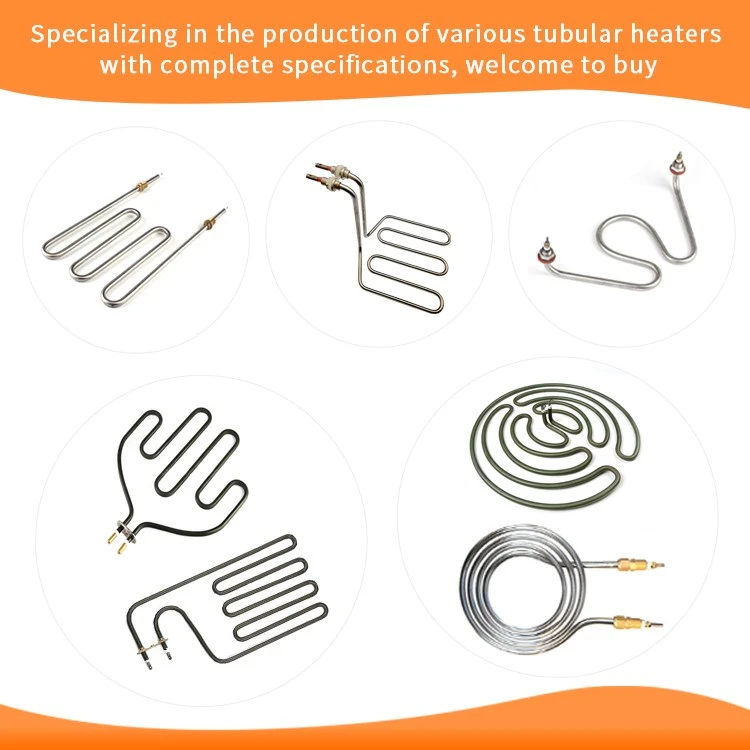
Calrod (sealed element): A fine coil of nickel-chromium wire with a ceramic binder, enclosed within a sturdy metal shell. These can be straight (as in toasters) or curved to fit smaller spaces (such as in electric stoves, ovens, and coffee makers).
Heat Lamps: High-power incandescent lamps, typically operated at less than maximum power, radiate primarily infrared radiation rather than visible light. These are commonly found in radiant space heaters and food warmers, taking the form of long tubes or R40 reflector lamps. Reflector lamp styles are often tinted red to minimize visible light production; tubular forms are always clear.
PTC Ceramic Heaters: This material is named for its positive thermal coefficient of resistivity. Most ceramics have a negative coefficient; most metals have a positive one. While metals do become slightly more resistive at higher temperatures, these ceramics (typically barium titanate and lead titanate composites) have a highly nonlinear thermal response, so PTC heaters become very resistive above a composition-dependent threshold temperature. This behavior causes the material to act as its own thermostat, as current flows when it's cold but not when it's hot. Thin films of this material are used in automotive rear window defrost heaters, while honeycomb elements are used in more expensive hair dryers and space heaters.
High-Temperature Heating Elements
Heating elements for high-temperature furnaces are often made of exotic materials, including platinum, molybdenum disilicide, and silicon carbide. Silicon carbide igniters are common in gas ovens.
For many applications, heating elements can be made from wire or strip of nickel-chromium alloys or iron-chromium-aluminum alloys. These can produce furnace temperatures up to 1280°C (2336°F). For furnace temperatures up to 1600°C (2912°F) or lower temperatures requiring high power input, silicon carbide heating elements are often the ideal choice. For furnace temperatures up to 1800°C (3272°F) and some other applications, molybdenum disilicide heating elements can provide the answer.
Metal Alloys in Wire/Strip/Rod: For furnace temperatures up to 1250°C, nickel-chromium alloys (NiCr) or iron-chromium-aluminum alloys are often the ideal, low-cost solution.
Silicon Carbide: For furnace temperatures up to 1600°C, silicon carbide components typically offer rapid heating and very long service life. To obtain optimal performance from SiC components, the power supply must be appropriately designed for the application. Some power adjustment methods are often required to accommodate the resistance variations that can occur with this type of component.
Molybdenum Disilicide: For furnace temperatures up to 1700 or 1800°C, molybdenum disilicide elements provide a reliable heat source. In some cases, processes operating at much lower temperatures may find them advantageous.