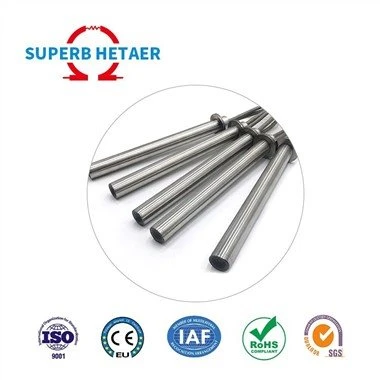
What is the difference between single-core armored thermocouple and armored thermocouple
Leave a message
The thermoelectric potential of the armored thermocouple will increase as the temperature of the measuring end increases. The size of the thermoelectric potential is only related to the material of the thermocouple conductor and the temperature difference between the two ends, and has nothing to do with the length and diameter of the thermocouple.
The two ends of the conductors of two different components are welded to form a loop. The direct temperature measuring end is called the working end, and the terminal end is called the cold end, also known as the reference end. When there is a temperature difference between the working end and the reference end, a thermal current will be generated in the loop. When the display instrument is connected, the corresponding temperature value of the thermoelectric potential generated by the thermocouple will be indicated on the instrument.
The single-core armored thermocouple belongs to the third generation of thermocouples. There is only one core in the protective sleeve. It is a new concept thermocouple developed on the basis of assembled thermocouples and armored thermocouples.
It has higher accuracy, higher reliability, more stable quality, more convenient processing and use, and lower cost, which has greatly promoted the technological progress of the industry. What is the difference between single-core armored thermocouple and armored thermocouple
Structural principle of armored thermocouple
It is made of conductor, high-insulation magnesium oxide, outer jacket 1Cr18Ni9Ti stainless steel protection tube, and is drawn in one piece many times. The armored thermocouple product mainly consists of junction box, terminal block and armored thermocouple as the basic structure, and is equipped with various installation and fixing devices.
Armored thermocouples are divided into insulated type and shell type.
It has many advantages such as bending, high pressure resistance, fast thermal response time and durability. It is used as a temperature sensor for measuring temperature, like industrial use, through compensation wire and display instrument, recording instrument and electronic regulator. At the same time, it can also be used as a temperature sensing element. It can directly measure the temperature of liquid, steam and its gas medium and solid surface in the range of 0℃~800℃ in various production processes. Compared with, armored thermocouples have the advantages of bendability, high pressure resistance, short thermal response time and durability.
Thermocouple temperature measurement principle
It is based on thermoelectric effect. When two different conductors or semiconductors are connected into a closed loop, when the temperatures at the two junctions are different, a thermoelectric potential will be generated in the loop. This phenomenon is called the thermoelectric effect, also known as the Seebeck effect.
As a temperature measurement sensor, armored thermocouples are usually used in conjunction with temperature transmitters, regulators and display instruments to form a process control system to directly measure or control the temperature of fluids, steam and gas media and solid surfaces in the range of 0-1800℃ in various production processes.
Armored thermocouples have many advantages such as bendability, high pressure resistance, fast thermal response time and durability. Like industrial assembled thermocouples, they are used as temperature measurement sensors and are usually used in conjunction with display instruments, recording instruments and electronic regulators.
Calibration method of armored thermocouples
Calibration method and device for metal melt fast armored thermocouples.
The device is mainly composed of a flat heating coil that can accommodate two quartz tubes at the ends of the measured couples, two armored thermocouples with the same shape as the measured couples, and a corresponding temperature control display output device.
Verification method:
First, use two calibration thermocouples to find the point in the flat heating coil that makes the thermoelectric potential of the two calibration thermocouples the same, replace one of the calibration thermocouples with the tested thermocouple, and when other conditions remain unchanged, wait for the reading of the tested thermocouple to stabilize and compare it with the reading of the calibration thermocouple to know whether the value of the tested thermocouple is accurate.
Features:
a. The device consists of a flat heating coil, a pair of calibration armored thermocouples and a temperature control display output device.
b. The verification method is to first insert the two calibration thermocouples from both ends of the heating coil relative to each other so that the hot ends of the armored thermocouples are in contact, and change the position of the calibration thermocouple in the heating coil to make the thermoelectric potential of the two calibration thermocouples the same, replace one of the calibration thermocouples with the tested fast thermocouple, read its thermoelectric potential value in a stable state and compare it with the thermoelectric potential of the calibration thermocouple to know the accuracy of the tested fast armored thermocouple.