What is the working principle of a spring-loaded thermocouple
Leave a message
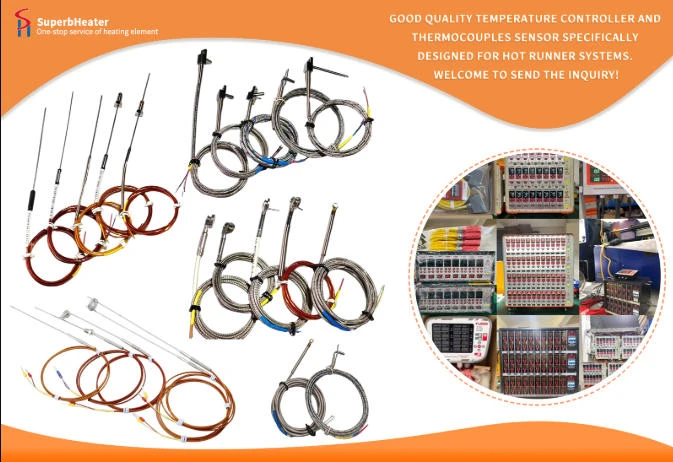
The term "snap-ring thermocouple" is not a standard industrial term; it is actually a common name for a spring-loaded thermocouple, a type of surface contact temperature sensor. Its core principle is not to change the sensing principle of the thermocouple itself, but rather to achieve constant pressure contact between the thermocouple's measuring end and the surface of the object being measured through a mechanical spring mechanism. This significantly reduces contact thermal resistance and improves temperature measurement accuracy and response speed.
Working Principle and Physical Mechanism
Thermoelectric Effect Basis: Based on the Seebeck effect, when two different metals (such as nickel-chromium/nickel-silicon K-type) form a closed circuit and there is a temperature difference between the two ends, a thermoelectric potential proportional to the temperature difference will be generated in the circuit. This potential is then converted into a temperature reading by an instrument.
Spring Pressure Mechanism: The built-in compression spring is pre-tensioned during installation, continuously applying a radial pressure of 5–20 N, forcing the thermocouple's measuring end (hot junction) to tightly contact the measured surface (such as metal pipes, motor casings, injection molding machine barrels), eliminating air gaps and achieving solid-solid heat conduction, rather than relying on convection or radiation.
Heat Conduction Optimization: The spring pressure flattens the microscopic unevenness of the contact surface, maximizing the contact area. The thermal resistance can be reduced to 1/3–1/5 of that of traditional non-pressurized methods, significantly improving response speed (≤5s) and stability.
Structure and Key Components
|
Component |
Material/Characteristics |
Function Description |
|
Thermocouple |
Type K (nickel-chromium-nickel-silicon), Type J, or Type E alloy wire |
Generates thermoelectric potential, conforms to IEC 60584 standard |
|
Protection Tube |
304/316L stainless steel or ceramic |
Protects the thermocouple, corrosion-resistant, high-temperature resistant (up to 400℃) |
|
Spring Mechanism |
Stainless steel compression spring, adjustable preload |
Provides constant contact pressure, compensates for thermal expansion and contraction |
|
Mounting Bolt |
M12×1.5 or M16×2 thread |
Fixed to the base of the tested equipment, acts as a spring reaction force support point |
|
Flexible Extension Wire |
High-temperature resistant insulation material (e.g., fiberglass braiding) |
Allows bending radius ≥ 5 times the wire diameter, adapts to vibration and displacement |
|
Junction Box |
IP65 protection, explosion-proof optional (Ex d IIC T6) |
Sealed wiring terminals, prevents environmental interference |
Key Differences from Screw-in and Compression Fitting Types
|
Type |
Installation Method |
Contact Object |
Does it damage the equipment? |
Applicable Scenarios |
|
Spring-loaded (Compression Spring Type) |
Spring presses against the surface |
Outer surface of the tested object |
No |
Surface temperature monitoring, non-invasive, removable |
|
Screw-in Type |
Threaded into a hole |
Inside the medium or inner wall of the pipe |
Yes (requires tapping) |
Fluid temperature measurement in pipes and containers |
|
Compression Fitting Type |
Compression fitting cone surface presses |
Inner wall of the opening |
No (only requires a smooth hole) |
Small diameter bypass, temporary temperature measurement, hygienic environments |
Typical Application Scenarios and Engineering Value
|
Industry |
Application Location |
Advantages |
|
Plastic Injection Molding |
Injection molding machine nozzle, barrel outer wall |
Quick replacement, avoids downtime for mold removal, fast thermal response ensures melt temperature control |
|
Motors and Bearings |
Motor casing, bearing surface |
Real-time monitoring of temperature rise, prevents overheating and burnout, supports predictive maintenance |
|
Food Processing |
Sterilizer outer wall, conveyor belt roller |
Complies with GMP residue-free requirements, easy to clean, no risk of sealing material aging |
|
Iron and Steel Metallurgy |
Continuous casting mold outer wall, rolling mill surface |
Stable contact at high temperatures (≤400℃), vibration resistant, replaces infrared temperature measurement. |
|
Laboratory |
Small reactor outer wall, hot plate surface |
Portable, adjustable depth, supports multi-point comparative experiments. |
Installation and Usage Points
Clean the surface to be measured before installation, remove oil and oxide layers, and ensure the contact surface is flat;
Use a torque wrench to tighten the mounting bolts, recommended torque: 10–15 N·m, to avoid overload causing spring failure;
Avoid using in strong vibration or impact environments (such as large compressors, stamping equipment), as this can easily lead to spring fatigue;
Regularly check whether the spring is loose or corroded, and replace the spring assembly if necessary, rather than the entire probe.
The essence of the snap-ring thermocouple is a "non-invasive surface temperature measurement interface," and its value lies in achieving high-precision, repeatable, and rapid deployment of temperature acquisition without modifying the equipment. It is one of the key sensing methods for modern industry to achieve flexible monitoring and predictive maintenance.