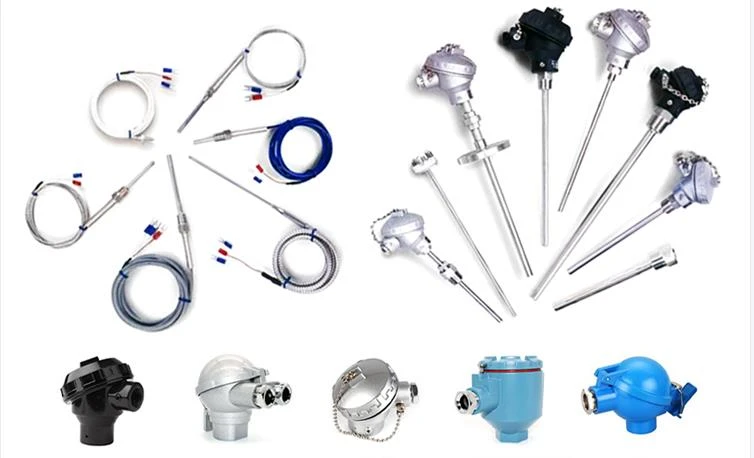
What's going on with wall thermocouple temperature measurement
Leave a message
Wall thermocouple temperature measurement is a commonly used temperature measurement method that uses the thermoelectric effect to measure the surface temperature of an object. It consists of a thermocouple at the contact point with the wall, and by measuring the voltage between the two ends of the thermocouple, the surface temperature of the object can be calculated. One end of the thermocouple is in contact with the surface of the measuring object, and the other end is connected to a thermometer or data acquisition system to determine the temperature by calculating the voltage generated by the thermoelectric effect.
The wall thermocouple temperature measurement utilizes the principle of thermoelectric effect. The thermoelectric effect refers to the voltage difference that occurs when there is a temperature difference at the contact between two different materials. In a wall thermocouple, two different materials of thermistors are connected. When the wall temperature changes, heat is transmitted to the thermocouple through the thermistor, causing a change in voltage. By measuring this voltage change, the wall temperature can be calculated.
Wall thermocouple temperature measurement is widely used in industrial production, scientific research experiments, environmental monitoring and other fields. It can measure the temperature of various materials, including metals, ceramics, plastics, etc. Due to its high temperature measurement, fast response speed, and simple structure, wall thermocouples are widely used in various occasions that require surface temperature measurement.
Wall thermocouple temperature measurement has the following advantages:
Wall thermocouple temperature measurement can achieve high temperature measurement, with an error range usually within a few degrees Celsius.
The wall thermocouple is very sensitive to temperature changes and can monitor temperature changes in real-time.
The wall thermocouple is composed of a small amount of material, with a simple structure and easy manufacturing and installation.
Although wall thermocouple temperature measurement has many advantages, there are also some limitations:
The accuracy of wall thermocouple temperature measurement is easily affected by environmental factors, contact pressure, contact area, and other factors.
The temperature measurement range of wall thermocouples is usually between -200 ℃ and 800 ℃, and exceeding this range may not work properly.
Wall thermocouple temperature measurement is a very commonly used temperature measurement method that uses the thermoelectric effect to measure the surface temperature of an object. It has the advantages of high, fast response, and simple structure, and is widely used in various fields. Although the accuracy of wall thermocouple temperature measurement is affected by some factors and the temperature measurement range is limited, it is still a very important and practical temperature measurement technology.