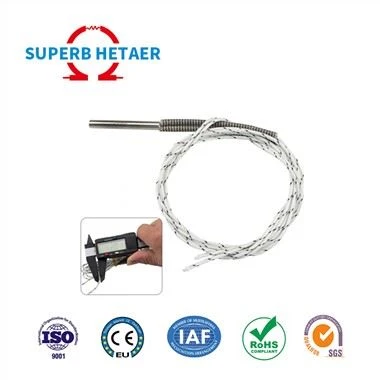
Why Invest in Small Thermocouples for Your Measurement Needs?
Leave a message
Small thermocouples have become a surprising answer for many different uses in the complex field of measuring technology. These little but mighty tools are a good investment for different measuring requirements as they provide several advantages.
Usually functioning based on the Seebeck phenomenon, thermocouples are temperature-sensing devices. A voltage produced when two distinct metals are coupled at a junction and subjected to a temperature gradient is commensurate with the temperature difference. Small thermocouples use this basic idea and expand their applications to fresh degrees of relevance.
Small thermocouples' capacity to provide exact readings in limited areas is one of the main reasons one should invest in them. Many tools and systems in contemporary technology are becoming ever smaller. From the complex microelectronics' circuits to the delicate parts of medical implants, space is scarce. These small thermocouples may be easily incorporated into these small spaces to provide precise temperature control without compromising important real estate.
For example, take cellphones' manufacture. Within these portable gadgets, the CPU, battery, and display among other parts create heat while running. Near these heat-generating devices, small thermocouples may be positioned to monitor their temperature. This helps producers make sure the gadget runs within reasonable temperature limitations, therefore avoiding overheating and any damage. It would be rather difficult to get reliable temperature data within the constrained area of such devices without tiny thermocouples.
Small thermocouples also have much improved spatial resolution. These thermocouples can provide thorough information about the temperature distribution in situations where temperature gradients span a short region. Their tiny scale lets them be arranged in a dense array, therefore enabling a more complete knowledge of the temperature field.
tiny thermocouples are very useful in research labs for investigating the thermal behavior of tiny samples or in the creation of novel materials with particular thermal qualities. For a micro-sized composite material, for instance, many tiny thermocouples may be positioned deliberately to record the temperature changes during heating or cooling cycles. Optimizing the material's performance depends on a better understanding of its thermal properties, which this thorough temperature mapping enables for.
Furthermore quick reaction times are provided by small thermocouples. Their quite low thermal mass allows them to respond fast to temperature variations. This feature is very important in situations where immediate response is required for process control or when fast temperature fluctuations are typical.
Imagine a high-speed industrial operation like a printing press where the temperature of the printing rollers has to be closely monitored. Small thermocouples very instantly detect any abrupt temperature changes. This enables operators to instantly change the heating or cooling systems, therefore guaranteeing constant print quality. Should the thermocouples exhibit a delayed reaction time, wasted resources and poor prints may result.
Moreover, in certain uses tiny thermocouples are typically more cost-effective than bigger equivalents. Particularly if many of them are needed for broad temperature-monitoring networks, their smaller size and simpler design may lead to reduced production costs. Small thermocouples also provide a more cost-effective alternative in situations where space restrictions would normally call for intricate and costly changes to suit bigger thermocouples.
Small thermocouples may be readily placed inside the server racks in a large-scale data center, for instance, where hundreds of servers must be watched for temperature. In terms of the original investment and long-term maintenance, the cost reductions attained by adopting tiny thermocouples in such a situation are really notable.
Apart from these useful features, tiny thermocouples are very flexible. Manufacturers may adjust the materials, wire diameters, and other factors to satisfy the particular needs of many uses. This degree of customizing guarantees that the thermocouples may provide the most precise and consistent temperature readings available.
Small thermocouples may be tailored to resist high temperatures, radiation, and mechanical stress in the sector of aerospace, where special needs and harsh environments are the norm. They may be made to suit the limited space of aircraft engines or satellite components, therefore providing vital temperature data for the safe and effective running of these systems.
Investing in compact thermocouples for your measuring requirements has several benefits. In many different sectors and research areas, their capacity to operate in limited areas, give improved spatial resolution, deliver rapid reaction times, be cost-effective, and be highly adaptable makes them indispensable tool. Small thermocouples will only become more valuable as technology develops and the need for precise and quick temperature measuring in small-scale settings increases.