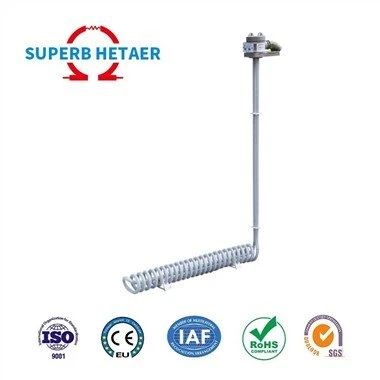
Application and precautions of industrial high-power flange heating tubes
Leave a message
Typical Applications
Petrochemical: Heating crude oil, asphalt, reactors, etc.
Natural Gas: Heat tracing for liquefied gas storage tanks and pipelines
Pharmaceutical/Food: Heating or sterilizing materials in explosion-proof environments
Paints/Coatings: Heating flammable solvents
Other: Hazardous areas such as mines and dusty environments (e.g., pulverized coal silos).
Key Selection Parameters
Explosion-proof rating: Select based on ambient gas type (e.g., IIA, IIB, IIC) and temperature class (T1-T6).
Power and Voltage: Common voltages are 220V/380V. Power must be calculated based on the heating medium and heating rate.
Flange Standards: ANSI, DIN, GB, etc., must be compatible with the on-site interface.
Pressure Rating: Select based on the vessel or pipeline pressure (e.g., 1.0 MPa, 1.6 MPa).
Customization Options: Bend shape, sheath material, lead length, etc.
Safety Precautions
Installation Specifications: Ensure flange sealing to prevent leakage. Regular inspections: Check insulation resistance, grounding reliability, and explosion-proof surface integrity.
Avoid dry-burning: Use with a liquid level control or flow switch.