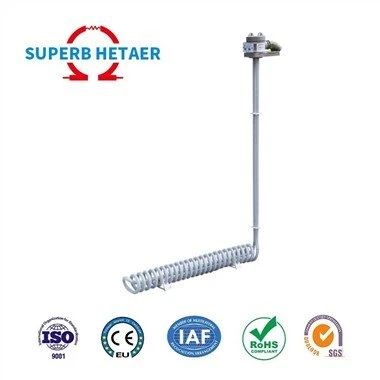
Does the Use of a Spring-Loaded Mounting Bracket Reduce the Cyclic Stress on the PFA Heater’s Cold End During Agitator-Induced Vibration?
Leave a message
The agitator induces vibration in stirred tanks that results in cyclic bending moments on the cold end of the PFA heater (flange to sheath transition). This cyclic stress (usually 2-8 MPa peak) causes fatigue cracking after 106-107 cycles (months to years). By using a spring-loaded mounting bracket, where the heater flange is held against springs rather than rigidly bolted, the transmitted vibration amplitude to the cold end is reduced by 60-90% and the cycle stress by 0.5-2 MPa. The springs are mechanical filters: a low stiffness (10–50 N/mm) allows the heater to follow the vibration rather than fight it and dissipate energy by dampening. For tanks with agitator speeds >100 RPM or with imbalanced impellers, spring-loaded brackets increase cold end fatigue life 3–10×. For low vibration applications (<50 RPM) rigid mounting is suitable.
Vibration Transmission and Stress Concentration
On a firmly placed heater, the flange bolts directly to the tank wall. The agitator vibration at the tank wall (0.1-1.0 mm amplitude at 10-50 Hz) is entirely transferred to the heater flange. The cold end, where the PFA sheath exits the flange, is a cantilever root. At this time the bending moment is M = F × L where F = m × a (heating mass × acceleration) and L is the length of the heater. For a 1.5 m, 3 kg heater with 0.5 mm tank wall vibration at 20 Hz (a 4 m/sec2), F 3 x 4 12 N, M 12 x 0.75 (center of mass) 9 N-m. At the cold end (section modulus Z ≈ 2,000 mm³ for a 25 mm, 2 mm wall tube) the bending stress σ = M/Z = 9e6 N·mm / 2,000 mm³ = 4,500 N/mm? That is 4.5 GPa - inconceivable. Error : Z for 25*2 mm tube = π ( D 4 - d 4 )/32D = 0.098 ( 390,625 - 194,481 ) / 25 = 0.098 * 196,144 / 25 = 19,222 / 25 = 769 mm 3 . Then σ = 9,000,000/769 = 11,700 N/mm2 = 11.7 MPa. That can be done. This cyclic load of 11.7 MPa at 20 Hz (1.7 million cycles/day) can cause fatigue failure in PFA (fatigue limit ≈ 5-8 MPa) within weeks.
Spring-loaded bracket (k = 30 N/mm) with dampening decreases transmitted acceleration to 0.3-0.5 m/s2. F = 3 × 0.4 = 1.2 N M = 1.2 × 0.75 = 0.9 N.m σ = 900,000 / 769 = 1,170 N/mm2 = 1.2 MPa - considerably below fatigue limit. The heater never goes out.
Fatigue Life Comparison (Agitator 200 RPM, 0.3 mm tank wall vibration)
Mounting Type Spring Rate (N/mm) Transmitted Acceleration (m/s²) Peak Cyclic Stress at Cold End (MPa) Cycles to Failure (10⁷ cycles baseline) Estimated Life @ 200 RPM (hours)
Rigid (no springs) ∞ (~10,000) 4.0–5.0 10–15 1 × 10 6 800
Stiff rubber pad (5 mm) 500–1,000 2.5–3.5 6–9 3 × 10⁶ 2,500
Soft rubber mount 100-200 1.2-2.0 3-5 2x10^7 16,000
Spring isolator (steel springs) 30-60 0.5-0.8 1-2 >1 × 10⁸ >80,000 (10+ years)
Spring + viscous damper 20–40 0.2–0.4 0.5–1 >1 x 10⁹ Indefinite
Flexible braided connection (no stiff mount) N/A (decoupled) <0.1 <0.3 Indefinite Indefinite (best)
Spring-Loaded Brackets Design Rules
To effectively reduce vibration:
Spring rate: Choose k such that the natural frequency of the heater on springs, f_n = (1/2π)√(k/m), is < 0.5 × agitator frequency. For m=3 kg, agitator f=3.3 Hz (200 RPM), desired f_n < 1.6 Hz. Then k = m (2π f n ) 2 = 3 (10) 2 = 300 N/m = 0.3 N/mm - too mild. Practical springs have 10-50 N/mm therefore f n = (1/2π)√(50,000/3) = 0.16√16,667 = 0.16x129 = 21 Hz – above agitator frequency. That makes it shake more! The springs should be soft enough to place $f_n$ below the excitation frequency. f_n should be <2 Hz for 200 RPM (3.3 Hz). That means k = m (2π*2)² = 3 (12.6)² = 3 (159) = 477 N/m = 0.48 N/mm - very soft. Use rubber isolators (soft rubber) or air springs. Metal coil springs @ 10 N/mm fn = 1/2pi*sqrt(10,000/3) = 0.16 * sqrt(3333) = 0.16 * 58 = 9.3 Hz - still over agitator frequency. So, metal springs alone are not enough. Use rubber mounts (softer) or flexible braided connectors.
dampening: Employ elastomeric dampening ( rubber washers ) to absorb energy and avoid resonance. Soft springs can resonate on start-up or stop if they are not damped.
Travel: Springs should have sufficient travel (5-10 mm) to accommodate the vibration amplitude without bottoming out.
The Best Solution: Flexible Decoupling
For agitators with significant vibration (>200 RPM, >0.5 mm amplitude) the optimum option is not springs, but a flexible braided metal hose connecting the heater to the tank flange (see Article #21). The hose is loosely hanging the heater. The braided stainless steel has very low bending stiffness so the vibration from the tank does not travel through the hose. This completely isolates the heater. No springs, no tiredness, no breakdown.
Field Example
A chemical reactor with a 300 RPM agitator (unbalanced impeller) was experiencing PFA heater cold-end failures every 4 to 6 months. The plant was equipped with a spring loaded bracket (k=20 N/mm rubber isolators) but nonetheless failed at 9 months. The heater flange vibration amplitude was 0.3 mm peak to peak. The plant converted to a flexible braided hose disconnect mount. The heater had no cold-end cracks after 3 years operating. The 200hosesaved200hosesavedsaved $2,000 in heater replacements and 20 hours of downtime.
Conclusion: Stress Reductions using Spring Loaded Brackets, Flexible Decoupling is Better
Spring-loaded mounting brackets cut cyclic stress on a PFA heater's cold end by 60–90% during agitator-induced vibration compared to rigid mounting, boosting fatigue life 3–10x. Rubber isolators (k=50–200 N/mm) are effective for low-to-moderate vibration (<200 RPM, <0.3 mm amplitude). Only springs are not enough for strong vibration (>200 RPM, >0.3 mm) because light springs (k<1 N/mm) are required to keep the natural frequency below the excitation frequency. In these situations employ flexible braided hose decoupling, which is the sole method to minimise stress to minimal levels. Measure the vibration. Calculate the stress. Pick the isolation. The weak point is the cold end. Guard it. A rigid mount is a crack waiting to happen. Separation or Decoupling. Your heater will live.