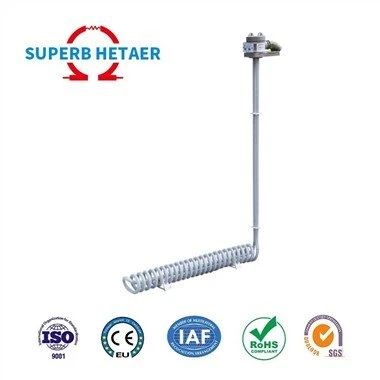
High efficiency stainless steel heating tube specifically designed for incinerators
Leave a message
Regarding trash disposal and incineration technology, the great efficiency stainless steel heating tube especially made for incinerators has become a critical part because it greatly improves the performance and efficiency of the burning process. Its special design and characteristics help to more efficiently use energy and manage waste as they are adapted to satisfy the demanding needs of this hostile and complicated surroundings.
The best heat transmission properties of the stainless steel heating tube help to explain its great efficiency. Excellent thermal conductivity of stainless steel lets the heating tube rapidly and effectively distribute heat to the waste products in the incinerator. In a municipal solid waste incinerator, for instance, the heating tube is used to quickly elevate the trash's temperature to the point of combustion efficiency. This effective heat transmission guarantees full and effective burning of the garbage, therefore lowering the unburned residue and raising the general incineration efficiency. Quick heating of the garbage also enables the incinerator to handle more waste in a shorter period, therefore improving the facility's throughput. A high efficiency heating tube is important for reaching the high temperatures needed for appropriate annihilation of the pollutants in an industrial waste incinerator handling a range of hazardous and difficult waste materials. It helps the incinerator to run more effectively, therefore lowering the energy needed per unit of garbage handled and so decreasing the environmental effect of the burning operation.
Further important elements influencing the great efficiency of the tube in an incineration environment are stainless steel's durability and corrosion resistance. Extremely difficult circumstances including high temperatures, corrosive gasses, and ash surround incinerators. Stainless steel guarantees the long-term dependability of the heating tube by being able to resist these circumstances without major deterioration. For example, the corrosive fumes generated during the burning of garbage like sulfur or chlorine may rapidly ruin regular heating tubes. Still, the stainless steel heating tube maintains its structural integrity and heat transmission effectiveness for a long time by resisting this corrosion. This longevity lessens the need for regular replacements and maintenance, therefore minimizing the possibility of expensive incinerator operating downtime. Maintaining a steady and effective incineration process depends on the dependability of the stainless steel heating tube, as in a large-scale waste-to- energy facility. It enables the plant to run without problems, thereby optimizing the energy recovery from the waste and reducing the running expenses related with tube replacement and maintenance.
Furthermore, the design of the high efficiency stainless steel heating tube for incinerators sometimes considers the particular needs of the burning process. Its design may enhance the contact area with the waste products, thus improving heat transmission. To maximize surface area within the burning chamber, some incinerator designs place the heating tube in a serpentine or spiral form. This guarantees that every bit of the trash is heated uniformly and quickly via more effective heat dispersion and improved contact with the waste. The high efficiency heating tube is coupled with contemporary incinerator systems with a sophisticated air flow and combustion control to maximize the incineration process. It maximizes the energy production and reduces emissions by working in harmony with the air supply and combustion chamber design to guarantee that the waste is burnt at the ideal temperature and with the correct level of oxygen. To guarantee the dependability and performance of the stainless steel heating tube, its production technique also follows rigorous quality criteria. The tube is kept homogeneous and of quality using precision engineering; thorough testing is carried out to confirm its heat transfer efficiency, durability, and corrosion resistance. By means of production and quality control, this meticulous attention to detail assures that the heating tube satisfies the stringent criteria of the incinerator application, therefore offering a dependable and effective means of waste disposal and energy recovery.
Ultimately, a major breakthrough in waste management and energy conversion is the great efficiency stainless steel heating tube especially intended for incinerators. Modern incinerator systems must have it as it combines corrosion resistance, longevity, and effective heat transmission. The need of such great efficiency heating tubes will only expand as the need for more sustainable and effective waste disposal options rises. Improving the incineration process, lowering trash quantities, optimizing energy recovery, and thus decreasing the environmental effect of waste burning depend on them greatly. These heating tubes, whether in a municipal or industrial environment, are pushing the development of incineration technology, therefore enabling a cleaner and more effective method of waste management and energy generation from waste. It marks a major technical development influencing the direction of the incineration sector and supporting the worldwide solutions for waste management and energy economy.