How Spring-Type Hot Runner Thermocouples Optimize Temperature Contact Effect
Leave a message
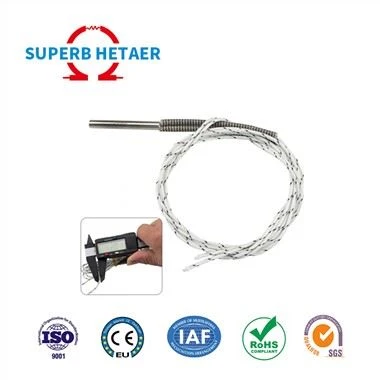
In hot runner installation, spring-loaded thermocouples are specifically made to address issues with inadequate contact temperature monitoring. They have developed into perfect matching components for nozzle heating sleeves and often vibrating temperature monitoring positions thanks to their integrated elastic compression structure, which significantly increases the stability and authenticity of temperature collecting.
Automatic elastic compression fitting is the main benefit. The internal spring can produce a long-lasting jacking force to press the detecting head up against the heated part's inner wall once it has been screwed into the installation hole. The elastic construction can automatically compensate for the spacing difference at all times, maintaining zero clearance contact condition forever, even if thermal expansion and contraction occur after prolonged high temperature operation, resulting in microscopic assembly gaps. This completely resolves low reading variation and temperature lag brought on by loose fitting of regular fixed thermocouples.
Spring thermocouples offer very low installation depth precision requirements in terms of installation tolerance flexibility. During assembly, the insertion dimension does not need to be rigorously controlled, and small errors in the reserved hole depth can be absorbed by the spring stroke. It saves a significant amount of debugging time for maintenance staff, significantly lessens the complexity of mold pre-processing and on-site installation operations, and is particularly appropriate for older molds with worn installation holes and incorrect alignment.
Its structural benefits are especially noticeable in high vibration work environments. Common thermocouples are easy to progressively loosen and shift under vibration force during frequent mold opening and closure and continuous injection impact, whereas spring type goods depend on elastic pre-tightening force to prevent position deviation. In long-term cyclic manufacturing, the contact state won't alter due to equipment vibration, guaranteeing that temperature feedback data stays steady and doesn't jump.
However, there are several restrictions on how spring thermocouples can be used. After prolonged baking at extremely high temperatures, the internal elastic components would eventually deteriorate and lose their elasticity, weakening the compression action and decreasing contact performance. As a result, they work well in traditional molding environments with medium temperatures. Integrated solid thermocouples continue to be more dependable in terms of durability for long-term steady high temperature operating regions. In order to achieve reasonable collocation, fully utilize the corresponding performance advantages, and enhance the overall temperature control level of the hot runner system, choose spring structures for positions that are difficult to install and easy to loosen, and use fixed integrated products for core high temperature measuring points.