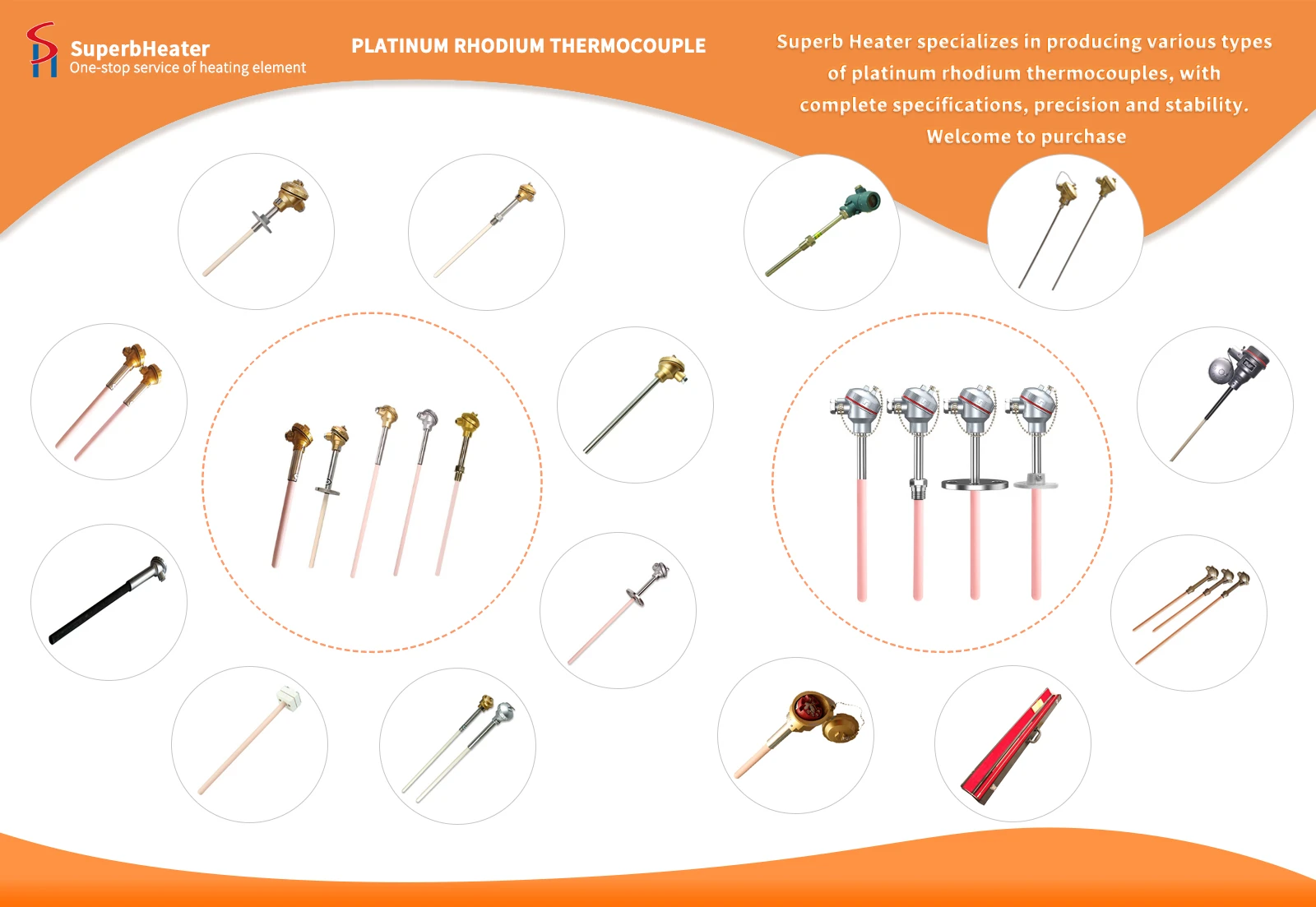
Platinum-rhodium thermocouple
Leave a message
Specific content of platinum-rhodium thermocouple
Platinum-rhodium thermocouple, also known as low-temperature precious metal thermocouple, is divided into three types: S-type thermocouple (platinum-rhodium 10-platinum thermocouple), R-type thermocouple (platinum-rhodium 13-platinum thermocouple), B-type thermocouple (platinum-rhodium 30-platinum-rhodium 6 thermocouple), mainly divided into single platinum-rhodium and double platinum-rhodium, suitable for various low-temperature places, widely used in glass, ceramics and industrial salt bath furnaces. Temperature measurement in the production process. Among them, S-type thermocouple is the most commonly used one in the domestic industry. Due to the high measurement temperature, the low temperature resistance of some stainless steel protective tubes can only reach 1000 degrees, and the price of stainless steel protective tubes above 1000 degrees is expensive, so corundum ceramic protective tubes are often used. High-purity corundum tubes can withstand low temperatures up to 1600 degrees, but the disadvantage is that they are fragile.
S-type thermocouple (platinum-rhodium 10-platinum thermocouple):
Platinum-rhodium 10-platinum thermocouple (S-type thermocouple) is a precious metal thermocouple. The wire diameter is specified as 0.5mm, and the allowable deviation is -0.015mm. The nominal chemical composition of the positive electrode (SP) is a platinum-rhodium alloy, which contains 10% rhodium and 90% platinum. The negative electrode (SN) is pure platinum, so it is commonly known as a single platinum-rhodium thermocouple. The maximum temporary application temperature of this thermocouple is 1300℃, and the maximum short-term application temperature is 1600℃.
S-type thermocouple has the highest survival rate in the thermocouple series, stability, wide temperature measurement range, and long service life. It has excellent physical and chemical properties, thermoelectric potential stability and good anti-oxidation performance at low temperatures, and is suitable for oxidizing and inert atmospheres. Because S-type thermocouples have excellent comprehensive performance, they are suitable for the application temperature scale. They have been used as interpolation instruments for temperature scales for a long time. Although "ITS-90" stipulates that they will no longer be used as external adjustment instruments for temperature scales, the Temperature Advisory Committee (CCT) believes that S-type thermocouples can still be used to approximately implement temperature scales.
The disadvantage of S-type thermocouples is the thermoelectric potential, the thermoelectric potential coefficient is small, the sensitivity reading is low, the mechanical strength is reduced at low temperatures, it is very sensitive to infection, and the precious metal material is expensive, so the one-time investment is relatively large.
R-type thermocouple (platinum-rhodium 13-platinum thermocouple):
Platinum-rhodium 13-platinum thermocouple (R-type thermocouple) is a precious metal thermocouple. The wire diameter is specified as 0.5mm, and the allowable deviation is -0.015mm. The nominal chemical composition of the positive electrode (RP) is a platinum-rhodium alloy, which contains 13% rhodium and 87% platinum. The negative electrode (RN) is pure platinum. The maximum temporary application temperature is 1300℃, and the maximum short-term application temperature is 1600℃.
R-type thermocouple has the highest existence, stability, wide temperature measurement range, and long service life in the thermocouple series. It has excellent physical and chemical properties, thermoelectric potential stability and good anti-oxidation performance at low temperatures, and is suitable for oxidizing and inert atmospheres. Because the comprehensive performance of R-type thermocouples is equivalent to that of S-type thermocouples, it has always been difficult to promote in my country. Except for its use in temperature measurement on imported equipment, it is rarely used in domestic temperature measurement. Between 1967 and 1971, three research institutions, NPL in the UK, NBS in the US and NRC in Canada, conducted a joint study. The results showed that the stability and reproducibility of R-type thermocouples are better than those of S-type thermocouples. my country has not yet carried out research in this area.
The disadvantages of R-type thermocouples are thermoelectric potential, low thermoelectric potential, low sensitivity, reduced mechanical strength at low temperatures, very sensitive to infection, and expensive precious metal materials, so the one-time investment is relatively large.
Type B thermocouple (platinum-rhodium 30-platinum-rhodium 6 thermocouple):
Platinum-rhodium 30-platinum-rhodium 6 thermocouple (type B thermocouple) is a precious metal thermocouple. The wire diameter is specified as 0.5mm, the allowable deviation is -0.015mm, the nominal chemical composition of the positive electrode (BP) is a platinum-rhodium alloy, which contains 30% rhodium and 70% platinum, and the negative electrode (BN) is a platinum-rhodium alloy, which contains 6% rhodium, so it is commonly known as a double platinum-rhodium thermocouple. The maximum temporary application temperature of this thermocouple is 1600℃, and the maximum short-term application temperature is 1800℃.
Type B thermocouple has the highest existence, stability, wide temperature measurement range, long service life and low temperature measurement limit in the thermocouple series. It is suitable for oxidizing and inert atmospheres, and can also be used in vacuum for a short time, but not suitable for reductive atmospheres or atmospheres containing metal or non-metal vapors. An obvious advantage of Type B thermocouple is that it does not require compensation wires for compensation, because the thermoelectric potential is less than 3μV in the range of 0~50℃.