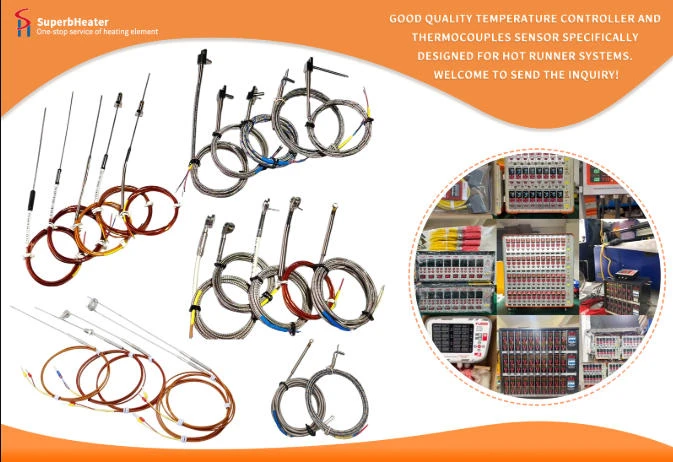
Research on Anti-vibration Design of Hot Runner Special Thermocouples
Leave a message
Strong mechanical vibration will be produced during high-frequency mold opening, shutting, and injection pressure impact during the actual production process of big injection molds. Vibration can readily cause loose installation, poor contact, signal hopping, and even internal wire core fracture in typical thermocouples. As a result, anti-vibration structural design is now a crucial component of high-end hot runner-specific thermocouples.
For high anti-vibration thermocouples, integrated one-piece forming technique is used for overall structural optimization. The integrated design avoids intermediate assembly gaps and loose connecting points, and all internal components are securely connected as a whole, in contrast to conventional segmented assembly structures. There will be no internal loosening or relative displacement between the wire core, protecting sleeve, and measuring head even under continuous strong vibration impact, which significantly increases the overall structural firmness and successfully prevents intermittent vibration-related signal defects.
Professional anti-loose thread construction and elastic compression placement design are incorporated to the fixed connection section. The anti-loose teeth pattern applied to the thread surface can successfully stop the thread from reversing and loosening during prolonged vibration. The probe can always maintain close contact with the measured metal surface, maintain stable heat conduction efficiency and consistent temperature measurement accuracy, and fully resolve the temperature deviation issue caused by vibration loosening thanks to the integrated spring compression structure's ability to automatically compensate the assembly gap caused by thermal deformation and vibration displacement.
The internal wire body is arranged in a loose buffer coil mode rather than a straight tension configuration, and flexible anti-fatigue alloy wire materials are chosen for the internal wire core architecture. This arrangement can spread local stress, buffer the tensile and shear forces produced by vibration, and significantly increase the wire core's tolerance to repeated bending and vibration. It is ideal for high-load continuous production molds and can sustain tens of thousands of cycles of vibration without breaking or being damaged.
Furthermore, the outside protective structure is reinforced. High-density, high-temperature resistant insulating filler is used to fill the space between the internal wire core and the thickened seamless metal protective sleeves. All internal components may be fixed without shaking thanks to the dense filler structure, which also serves as a good buffer and shock absorber. In the meantime, high-flexibility, vibration-resistant special wires that can adjust to the position deviation caused by mold movement are matched with the external connecting wires.
Such anti-vibration optimized thermocouples are widely utilized in heavy-duty stably functioning hot runner systems, multi-cavity high-speed production molds, and big vehicle injection molds in real-world application scenarios. It can effectively lower the failure rate caused by vibration, extend the service cycle of accessories, reduce frequent shutdown maintenance times, and create more stable and efficient continuous production conditions for injection molding enterprises, even though the production process is more complex and the manufacturing cost is slightly higher.333