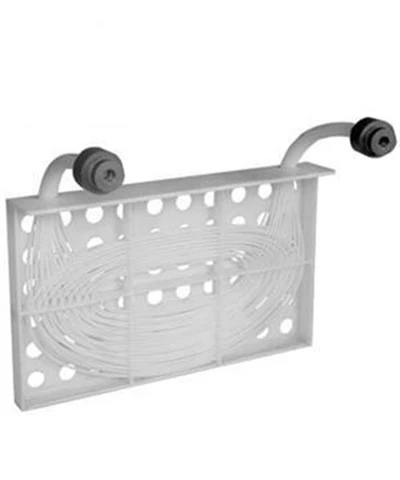
The structure and working principle of pipe heater
Leave a message
I believe that many people do not know what a pipe heater is. A pipe heater is an energy-saving device for preheating materials. It is installed before the material equipment to directly heat the material, so that it can circulate and heat at high temperature, and ultimately achieve the purpose of saving energy. It is widely used in the preheating of fuel oils such as heavy oil, asphalt, and clean oil. So, what is a water pipe heater specifically? Let me introduce it to you below, and I hope it will be helpful to you.
Pipe electric heater structure and working principle
(1) Pipe heater structure
The water pipe heater is composed of several parts such as multiple tubular electric heating elements, a cylinder, and a guide plate. The tubular electric heating element is a high-temperature resistance wire placed in a metal tube, and the gap is tightly filled with crystalline magnesium oxide powder with good insulation and thermal conductivity. The tubular electric heating element is used as a heating element, which has advanced structure, high thermal efficiency, good mechanical strength, corrosion resistance, and wear resistance. A guide baffle is installed in the cylinder to ensure that the water is heated evenly during circulation.
(2) Working principle
The water pipe heater uses a digital temperature regulator, a solid-state relay and a temperature measuring element to form a measurement, regulation and control circuit. During the electric heating process, the temperature measuring element sends the water pipe heater outlet temperature electrical signal to the digital temperature regulator for amplification, and displays the measured temperature value after comparison. At the same time, the signal is output to the solid-state relay input end, thereby controlling the heater, so that the control cabinet has good control accuracy and regulation characteristics. The interlocking device can be used to start and shut down the water pipe heater remotely.
Features of pipe heater
The pipe heater uses a stainless steel cylinder, which is small in size, occupies little space, is easy to move, and has strong corrosion resistance. A thickened insulation layer is used between the stainless steel liner and the stainless steel shell to minimize the degree of temperature loss, maintain temperature, and save electricity.
The main components of the high-quality heating element (stainless steel electric heating tube) are made of imported materials, and the processing process also uses advanced production equipment and processes. With different voltages, it can achieve the highest performance. Its insulation, pressure resistance, and moisture resistance are all higher than national standards, and it is safe and reliable to use.
The water flow direction is reasonably designed, the heating is uniform, there is no high or low temperature dead corner, and the thermal efficiency is high.
The pipe heater is equipped with a thermostat of a well-known domestic brand, and the user can set the temperature freely. All are equipped with overheat protectors to control the temperature and water shortage and over-temperature protection to avoid damage to the heating elements and the system.
Installation and use
The control cabinet should be installed in a dry and ventilated place that is easy to operate. The water pipe heater shell and the control cabinet shell should be reliably grounded, the water pipe heater should be installed horizontally, and the base nut should be tightened to make it stable. When installing the main body and the external pipe, pay attention to the inlet and outlet directions. Before using the water pipe heater, the insulation resistance between the power access terminal and the metal shell should not be less than 2MΩ, and the relative humidity of the use environment should not exceed 85%. The inlet and outlet ends of the power cord should be firm and reliable and should not be loose. Before use, first check whether the power cord and the output connection of the temperature measuring element are correct, and whether the components and nuts of the control cabinet are loose or damaged. If there is any abnormality, tighten or replace it in time. After confirmation, you can power on the test run. The main steps are as follows:
1. Close the water pipe switch, the power indicator light is on, the digital display control light is on and the measured temperature indication value is displayed.
2. Temperature setting
3. After the temperature is set, if there is no abnormality, press the "heater operation" button, the AC contactor is energized, the solid-state relay input terminal is energized, and the PID signal output by the digital display temperature control meter controls the heater operation. When the machine is turned on for the first time, temperature overshoot may occur, but it gradually tends to be within a constant range.
Maintenance and care
The water pipe heater, especially the control part, is a precision instrument. It should be handled with care during transportation. Impact and collision are strictly prohibited. The simplified part should be properly hoisted to avoid deformation and damage to the internal heating components. The water pipe heater and the control cabinet are placed in the warehouse and are strictly prohibited from being exposed to rain.
Common faults and repairs
Fault 1: The power indicator light is not on, the digital display does not work, and the voltmeter has no indication. Check whether the water pipe switch is closed and whether the control circuit fuse is intact.
Fault 2: The heater temperature does not rise. Check whether the fuse is intact and whether the electric heater is damaged?
Fault 3: Three-phase imbalance.
(1) Check whether the three-phase incoming line voltage is missing a phase.
(2) Open the protective cover of the water pipe heater, use a multimeter to check whether the single electric heating element is broken, and then replace it with a special matching wrench. Pay special attention not to damage the rubber gasket during replacement. If the rubber gasket is damaged, be sure to use a complete rubber gasket.
Classification of pipe heaters
Pipe heaters have a wide range of uses and can be divided into nitrogen heaters and hydrogen heaters according to the different heating gases. These can also be called pipeline gas heaters. Water pipe heaters and oil tank heaters, which can also be called pipeline liquid heaters.
1) Pipeline gas heaters
Gas heaters are electric heating devices that mainly heat gas flows. The heating element of the gas heater is a stainless steel electric heating tube. The inner cavity of the heater is equipped with multiple baffles (guide plates) to guide the gas flow and extend the retention time of the gas in the inner cavity, so that the gas is fully heated, the gas is heated evenly, and the heat exchange efficiency is improved. The heating element of the air heater, the stainless steel heating tube, is made by filling the seamless steel tube with electric heating wire, filling the gap with magnesium oxide powder with good thermal conductivity and insulation, and then shrinking the tube. When the current passes through the high-temperature resistance wire, the heat generated diffuses to the surface of the heating tube through the crystallized magnesium oxide powder, and then transfers to the heated air to achieve the purpose of heating.
2) Pipeline liquid heater
The so-called liquid heater uses benzoic acid as a heating agent. The metal wire reinforces the refractory fiber layer, and the double-layer coating layer tightly combined and distributed along the entire length of the resistance wire strands and the resistance wire strands in its center form an integral direct heating monomer that can be bent as needed and can be in close contact with the heated object. The heating monomer is repeatedly wound according to the shape and size of the heated object to form a belt sheet, and then multiple parallel monomers are horizontally woven together with metal wire to form a woven high-temperature electric heater that can be directly wrapped around the heated object.