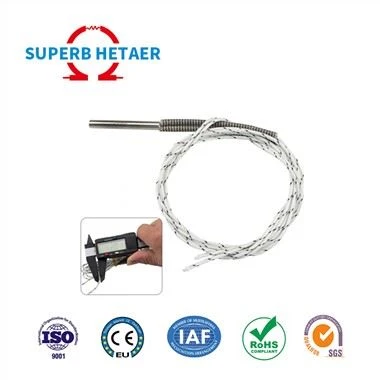
What are the causes of thermocouple failure
Leave a message
Let's take a look at the fault factors of thermocouples: Thermocouples are common temperature sensors that often experience malfunctions and errors during use due to various interference factors. There are 5 points:
1. Connection issue: Unexpected thermocouple junction caused by many measurement errors. Please remember, any intersection that may result in the intersection of two different metals. If you need to increase the length of your thermocouple wires, you must use the correct type of thermocouple extension wire (such as K-type thermocouple K-type). Use any other type of wire to introduce the junction of a thermocouple. The correct thermocouple material must be made and the correct polarity must be observed when using any connector.
2. Lead resistance: In order to minimize thermal shunt and improve response time, thermocouples are made of thin metal wires (in the case of platinum type, cost is also a consideration). This may result in thermocouples having high resistance, which can make them sensitive to noise, and may also lead to errors due to the input impedance of the measuring instrument. A typical thermocouple exposed at the junction of a 32AWG wire (0.25mm diameter) will have a resistance of approximately 15 ohms per meter. The picotc-082m Ω input impedance results in a 12 meter error of less than 0.01% for this cable. If a thin wire or long cable thermocouple is needed, it is worth keeping the thermocouple lead short and then using a thermocouple extension wire (which is much thicker and therefore has lower resistance) to run between the thermocouple and the measuring instrument. It is always a good preventive measure to measure the resistance of your thermocouple before use. The usual reason is the diffusion of atmospheric particles into metals at extreme operating temperatures. Another reason is the diffusion of impurities and chemicals into the insulation of thermocouple wires. If operating at high temperatures, check the specifications of the probe insulation layer.
3. Noise: The output from the thermocouple is a small signal, so it is easy to generate electrical noise. Most measuring instruments reject any common mode noise signals from the same two wires, so that the noise can be twisted together through the cable to help ensure that the two wires pick up the same noise signal with minimal interference. If working in a very noisy environment (such as near large motors), it is worth considering using shielded extension cords. If you suspect noise pickup, turn off all suspicious devices first and see if the readings change.
4. Common mode voltage: Although the thermocouple signal is very small, there is often a larger input from the voltage measuring instrument. These voltages may cause inductance to pick up (a problem when testing the temperature of motor windings and transformers), or at the junction of "grounding". A typical example is the measurement of temperature at the junction of a "grounded" hot water pipe and an uninsulated thermocouple. If there are any poor grounding connections between several volts, there may be pipelines and geodetic instruments present. These signals are in normal mode (with the same thermocouple wires), so they will not cause problems for most instruments and will not be too large. Preventive measures using the same cable noise overview can reduce common mode voltage or by using insulated thermocouples.
5. Thermal shunt: All thermocouples have a certain quality. The quality of heating and the amount of energy required can affect your attempt to measure temperature. Consider the example of liquid temperature measurement in a test tube: there are two potential issues. It is the heat energy that will go to the thermocouple wire and dissipate into the atmosphere, thereby reducing the temperature of the liquid around the wire. A similar problem may occur if not fully immersed in the liquid, due to the cold environment of the air temperature thermocouple on the wire, heat conduction may cause the junction of the thermocouple to have different temperatures with the liquid itself. Using thinner wire thermocouples may be helpful as it can cause a steep temperature gradient along the thermocouple wire at the interface between the liquid and the surrounding air. If using a thermocouple with thin wires, it is necessary to consider paying for the lead resistance. The use of thin wires to connect thermocouples to thicker thermocouple extension wires often provides a good compromise solution.