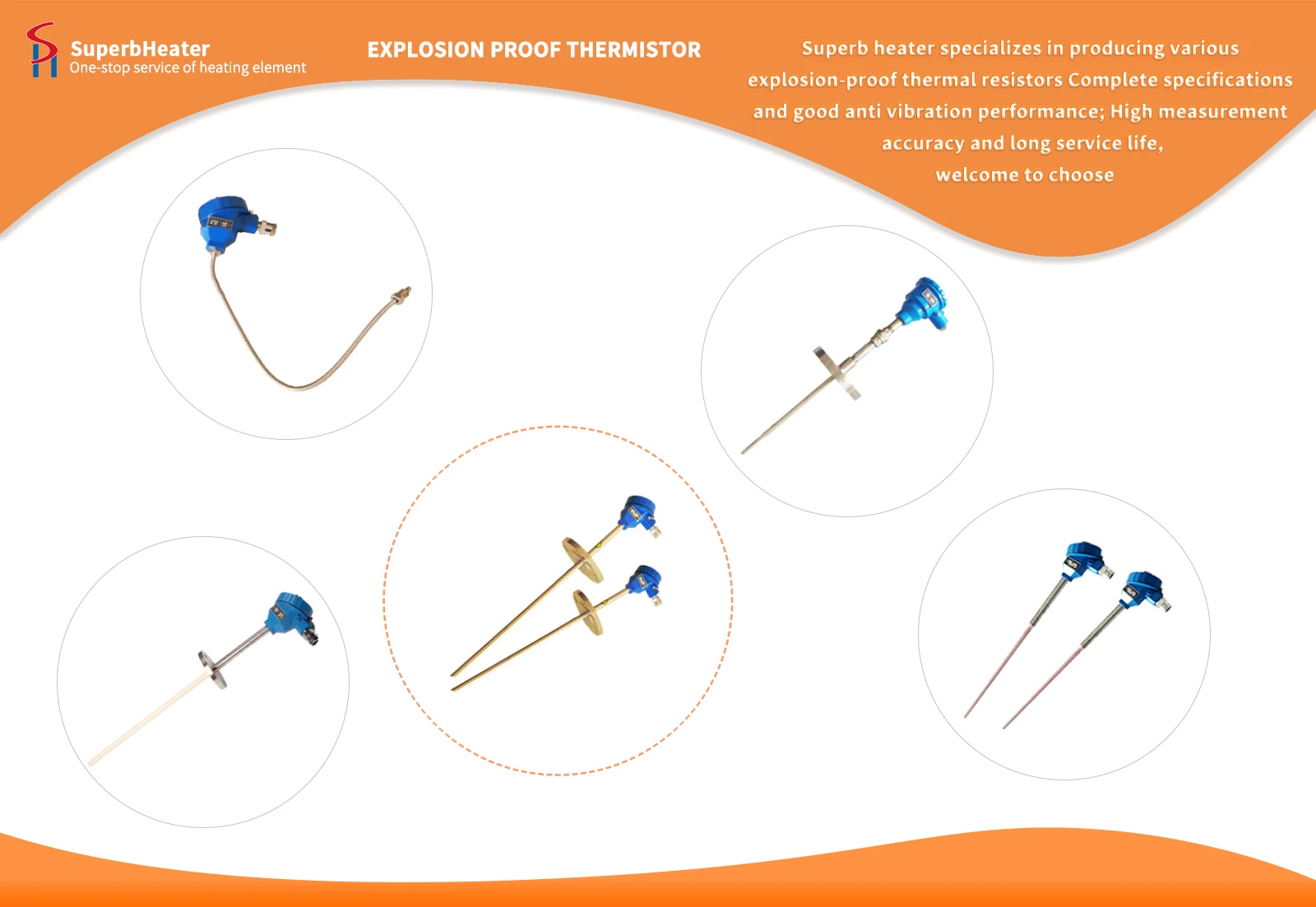
What is the difference between PT100 and PT1000 thermistor temperature sensors?
Leave a message
Why use a thermistor temperature sensor
The material of the resistance pin in the thermistor temperature sensor is platinum metal, hence it is also known as platinum thermistor. Platinum thermistors have several characteristics that make them particularly suitable for temperature measurement.
Almost linear temperature resistance relationship
High resistivity (59 ohms/cmf compared to nickel 36 ohms/cmf)
High stability and precision
Very chemically passivated
High resistance to pollution
In the thermistor temperature sensor, the resistance of PT100 is 100 ohms at 0 ℃, and the resistance of PT1000 is 1000 ohms at 0 ℃. The linearity of their characteristic curves, operating temperature range, and response time are the same. The temperature coefficient of resistance is also the same. However, due to different nominal resistances, the reading of the Pt1000 temperature sensor is 10 times higher than that of the Pt100 temperature sensor. When comparing 2-wire systems without temperature compensation, this difference is significant, as the measurement accuracy of Pt1000 is higher than that of Pt100.
Among these two types of temperature sensors, the Pt100 temperature sensor seems to be more popular than the Pt1000 temperature sensor for the following reasons:
The PT100 temperature sensor adopts a winding and thin film structure, providing users with choice and flexibility, while the PT1000 temperature sensor almost only requires a thin film.
Due to the widespread use of PT100 temperature sensors in various industries, it is more compatible with various display instruments, while PT1000 requires customization.
Some people may ask, why would someone choose the PT1000 temperature sensor? The following are the obvious advantages of PT1000:
The PT1000 temperature sensor performs better than the PT100 temperature sensor when used in a 2-wire system. For leads of the same length, the longer the wire, the greater the wire resistance, resulting in inaccurate temperature measurement. The PT1000 temperature sensor has a relatively large change in resistance, and the impact on wire resistance can be ignored.
The maximum current allowed for PT1000 is<=0.5mA, and the maximum current allowed for PT100 is<=5mA. This means that the PT1000 temperature sensor uses less power, resulting in less self heating and greater accuracy.
Generally speaking, PT100 temperature sensors are more commonly used in process applications, while PT1000 temperature sensors are used in cooling, heating, automotive, machine manufacturing, semiconductor and other applications.