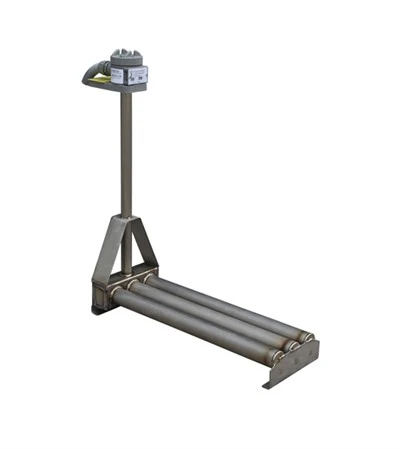
When a Titanium Heat Rod Is Used to Superheat Steam at 250°C and 10 bar, What Is the Maximum Allowable Oxygen Contamination in the Steam to Avoid Formation of Non-Adherent Oxide Flakes?
Leave a message
Titanium is protective in superheated steam at 250oC and 10 bar, forming a titanium dioxide (TiO2) scale. However, oxygen contamination of the steam above the typical dissociation of water vapor increases oxidation and affects the scale morphology. The surplus oxygen leads to the production of a thick, multi-layered scale including TiO₂ and sub-oxides such as Ti₂O₃ and TiO. This scale is non-adherent and spalls easily producing oxide flakes which can contaminate downstream equipment such as turbines, valves and heat exchangers. The oxygen contamination should not exceed 10 parts per million by volume (10 cm3 of O2 per m3 of steam) to prevent the development of non-adherent oxide flakes. The scale spalls between 500 and 1,000 hours of operation above this level.
Mechanism of oxygen-induced scale spalling in superheated steam
Normal steam oxidation reaction at 250°C Ti + 2H2O → TiO2 + 2H2. With the extra oxygen the reaction is Ti + O 2 → TiO 2 . The oxidation rate is proportional to the square root of the partial pressure of oxygen. The resultant oxide is thicker, more porous and contains micro-cracks. This is owing to growth stresses that are faster. The thick porous scale spalls easily on cooling or thermal cycling due to the mismatch of thermal expansion between the oxide and titanium metal. The spalled oxide flakes are carried by the steam flow and may damage downstream equipment. The spalled regions reveal new titanium which oxidizes rapidly . This leads to a cyclic scale growth and spalling .
Adherence and spalling on the quantitative scale vs. oxygen concentration
Scale characteristics for Grade 2 titanium have been developed for various amounts of oxygen contamination in controlled testing in superheated steam at 250°C and 10 bar for 1,000 hours. When the oxygen content is less than 1 ppm (pure steam), the scale thickness is 2-5 µm, the scale is adherent and dark gray and no spalling occurs after 1000 hours. With 1-5 ppm oxygen the scale thickness increases to 5-10 μm. The scale is adherent with minor surface cracking and no flakes are observed. At oxygen concentrations of 5-10 ppm the scale thickness is 10-20 µm, the scale starts to split at the edges and small flakes below 0.1 mm appear occasionally which is suitable for most industrial applications. Oxygen 10–25 ppm Scale thickness 20–40 µm Scale spalling 20–40% of surface after 500 hours Flakes created 0.1–0.5 mm This is not appropriate for clean steam systems. When the oxygen is above 25 ppm, the scale thickness is more than 50 μm, serious spalling occurs after 100–200 hours and big flakes larger than 0.5 mm are created, which is not suitable for any steam system.
Steam Temperature and Pressure Effects on Oxygen Tolerance.
The permissible oxygen concentration limit lowers as the steam temperature and pressure increase. The permissible oxygen for adhesive scale is 25 ppm at 200 °C and 8 bar limit being a scale thickness of 5–10 µm. At 250°C and 10 bar the allowable oxygen is reduced to 10 ppm with scale thickness 10-20 µm. At 300 °C and 20 bar, with a scale thickness of 15–30 µm, the maximum permitted oxygen is further reduced to 5 ppm. The permissible oxygen at 350°C and 40 pressure is just 2 ppm with a scale thickness of 20–40 µm. At 400 °C and 80 pressure, the allowed oxygen concentration is 1 ppm and the scale thickness is 30–50 μm. Higher temperature increases oxidation kinetics, hence tighter oxygen control prevents spalling.
Guide to Control of Oxygen Contamination in Superheated Steam Systems
Grade 2 titanium heaters. The accompanying table indicates recommendations of maximum allowed oxygen concentrations in superheated steam depending on service requirements and susceptibility of downstream equipment to oxide flakes.
Service Requirement Downstream Sensitivity to Oxide Flakes Maximum Allowable O2 (ppm) Expected Scale Thickness After 1,000 Hours (µm) Risk of Spalling
Clean steam for food or pharmaVery high <1 None 2-5
Industrial steamt low flake sensitivityLow <5 5 – 10 Low
Industrial steam, okay for the odd flakeModerate <10 10-20 Moderate
Service non criticalLow <25 20–40 High (likely flakes)
>50 Severe >25 Any Unacceptable
Oxygen Concentration Control: Beyond Engineering:
The grade of titanium has no major influence on the scale spalling at 250 °C, as Grade 2 and Grade 7 react equally in these conditions. Wall thickness is a metal loss allowance, 2.0 mm wall with a 0.01 mm per year oxidation loss, for 1,000 hours of operation, would last 200 years. The velocity of the steam flow effects the flake removal, high speeds (>20 m/sec) may dislodge scales even if they are ostensibly attached. Loose flakes can be removed by periodic steam purging at 50 m/s for 1 h before they build up. An oxygen analyzer in the steam line continuously monitors, and an alert set at 8 ppm O₂ permits remedial measures to be taken before the 10 ppm limit.
Creating a well informed specification
For a titanium heat rod for superheating steam at 250°C and 10 bar, the oxygen content in the steam source must be below 5 ppm for clean steam applications or below 10 ppm for industrial use. Install an online oxygen analyzer with an alarm at 8 ppm and an interlock that cuts heater power or shuts down the system if oxygen is above 15 ppm. Existing systems with O2 levels > 10 ppm Reduce steam temperature to 200°C which permits 25 ppm O₂ Install deoxygenation system During commissioning check the heater surface after 100 hours of operation. If oxide flakes are evident reduce the oxygen concentration or the temperature. Maintaining oxygen contamination below 10 ppm inhibits the production of non-adherent oxide flakes which would contaminate downstream equipment and degrade the life of heaters in superheated steam service.