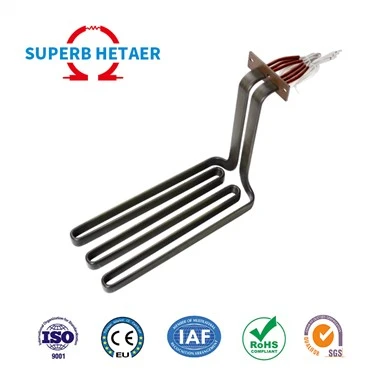
How to judge the quality of stainless steel electric heating coil?
Leave a message
To judge the quality of stainless steel electric heating coils, we can start from the following aspects:
Appearance inspection
Surface quality: The surface of high-quality stainless steel electric heating coils should be smooth and flat, without obvious scratches, cracks, pores, sand eyes and other defects. If the surface is rough, it may affect the heating effect and easily cause local overheating during use.
Welding process: Check the welding parts of the electric heating coils. The welding should be firm and uniform, without false welding or leaking welding. Good welding can ensure the reliable connection between the heating wire and the electrode, reduce the contact resistance, and avoid problems such as overheating and sparking due to poor contact.
Dimensional accuracy: Measure the size of the electric heating coil, which should meet the product specification requirements and the dimensional deviation should be within the allowable range. Electric heating coils with accurate dimensions can better match the heated object and ensure the uniformity of heating.
Material inspection
Stainless steel material: Determine whether the material composition of stainless steel meets the requirements through methods such as spectral analysis or chemical analysis. For example, for 304 stainless steel, its main components should contain about 18% chromium, 8% nickel, etc. High-quality stainless steel has good corrosion resistance, high temperature resistance and mechanical strength, which can ensure that the electric heating coil is not easily damaged during long-term use.
Heating wire material: The heating wire is usually made of nickel-chromium alloy or iron-chromium-aluminum alloy. High-quality heating wire should have high resistivity, good high temperature resistance and oxidation resistance. The appearance of the heating wire can be observed. Its surface should be smooth, without oxide scale, and the diameter should be uniform. It can also be preliminarily judged whether its material is qualified by measuring the resistance value of the heating wire. The resistance value should be within the specified range.
Performance test
Insulation performance test: Use an insulation resistance tester to measure the insulation resistance of the electric heating coil. Its insulation resistance value should not be lower than the specified standard value, generally required to be above 500MΩ. Good insulation performance can prevent the occurrence of leakage accidents and ensure safe use.
Cold resistance test: When the electric heating coil is not powered on for heating, use a multimeter to measure its cold resistance. The cold resistance value should be consistent with the nominal value in the product specification, and the deviation is generally within ±5%. If the resistance value deviation is too large, it may be that the specifications of the heating wire are incorrect or there are quality problems.
Hot performance test: Install the electric heating coil on a suitable device for heating test. During the heating process, observe whether the heating rate of the electric heating coil is normal and whether the temperature distribution is uniform. You can use measuring tools such as thermocouples or thermometers to measure the temperature of different parts, and the temperature deviation should be within the allowable range. At the same time, check whether the electric heating coil has abnormal noise, odor or smoke in the working state.
Brand and certification
Brand reputation: Well-known brands usually have a good reputation and high credibility in the market, and their product quality is relatively more guaranteed. You can understand the reputation of the brand by checking the user reviews of the product, the industry reputation, and the history and scale of the brand.
Certification: Check whether the electric heating coil has passed relevant certifications, such as CE certification, UL certification, ISO 9001 quality management system certification, etc. These certifications are a recognition of product quality and safety, indicating that the product meets relevant international or domestic standards and requirements.