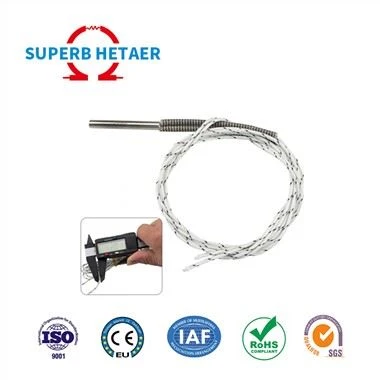
Thermocouple principle and structure
Leave a message
Thermocouples are one of the most commonly used temperature detection elements in the industry. Its advantages are:
① High measurement accuracy. Because the thermocouple is in direct contact with the object being measured, it is not affected by the surrounding medium.
② Wide measurement range. Commonly used thermocouples can measure continuously from -50~+1600℃, and some special thermocouples can measure as low as -269℃ (such as gold, iron, nickel, and chromium) and as high as +2800℃ (such as tungsten-rhenium).
③ Simple structure and convenient use. Thermocouples are usually composed of two different metal wires, and are not limited by size and termination. There is a protective sleeve outside, which is very convenient to use.
1. Basic principle of thermocouple temperature measurement
Weld two conductors or semiconductors A and B of different materials to form a closed loop. When there is a temperature difference between the two attachment points 1 and 2 of conductors A and B, an electromotive force is generated between the two, so a large current is formed in the loop. This phenomenon is called the thermoelectric effect. Thermocouples work by using this effect.
2. Types and structural composition of thermocouples
(1) Types of thermocouples
Common thermocouples can be divided into two categories: standard thermocouples and non-standard thermocouples. The standard thermocouples used refer to thermocouples whose thermoelectric potential and temperature relationship, allowable deviation, and unified standard scale are defined by national standards. They have matching display instruments for selection. Non-standard thermocouples are not as good as standardized thermocouples in terms of application scope or number of levels, and some have different scales. They are mainly used for measurements in certain special places. Standardized thermocouples
Since January 1, 1988, my country has produced all thermocouples and thermal resistors according to IEC standards, and the seven standardized thermocouples S, B, E, K, R, J, and T (i.e., scale numbers) are my country's unified design thermocouples.
(2) The structure of thermocouples In order to ensure that the thermocouple works reliably and stably, the following requirements are imposed on its structure:
① The welding of the two thermocouples that form the thermocouple must be firm;
② The two thermocouples should be well insulated from each other to prevent short circuits;
③ The connection between the compensation wire and the free end of the thermocouple should be convenient and reliable;
④ The protective sleeve should be able to ensure that the thermocouple is fully isolated from the harmful medium.
3. Temperature compensation of the cold end of the thermocouple
Since the materials of thermocouples are generally relatively precious (especially when precious metals are used), and the distance between the temperature measurement point and the instrument is very far, in order to save thermocouple materials and reduce costs, compensation wires are usually used to extend the cold end (free end) of the thermocouple to the control room with a relatively stable temperature and connect it to the instrument terminal. It must be pointed out that the role of the thermocouple compensation wire is only to extend the thermocouple and move the cold end of the thermocouple to the instrument terminal in the control room. It itself cannot eliminate the influence of the cold end temperature change on the temperature measurement and does not play a compensatory role. Therefore, other modification measures are needed to compensate for the influence of the cold end temperature t0≠0℃ on the temperature measurement.
When using the thermocouple compensation wire, it is necessary to pay attention to the matching of the model, the polarity cannot be connected incorrectly, and the temperature of the connection end of the compensation wire and the thermocouple cannot exceed 100℃.
For example: S-type thermocouple) Platinum-rhodium 10-platinum thermocouple
Platinum-rhodium 10-platinum thermocouple (S-type thermocouple) is a precious metal thermocouple. The wire diameter is specified as 0.5mm, and the allowable deviation is -0.02mm. The nominal chemical composition of its positive electrode (SP) is a platinum-rhodium alloy, which contains 10% rhodium and 90% platinum. The negative electrode (SN) is pure platinum, so it is commonly known as a single platinum-rhodium thermocouple. The maximum temporary application temperature of this thermocouple is 1300℃, and the maximum short-term application temperature is 1600℃.
S-type thermocouple has the highest stability, stability, wide temperature range, and long service life in the thermocouple series. It has excellent physical and chemical properties, thermoelectric stability and good anti-oxidation performance at low temperatures, and is suitable for oxidizing and inert atmospheres. Because S-type thermocouples have excellent comprehensive properties, S-type thermocouples that meet the application temperature scale have long been used as interpolation instruments for temperature scales. Although "ITS-90" stipulates that they will no longer be used as external adjustment instruments for temperature scales, the Temperature Advisory Committee (CCT) believes that S-type thermocouples can still be used to approximately achieve temperature scales.