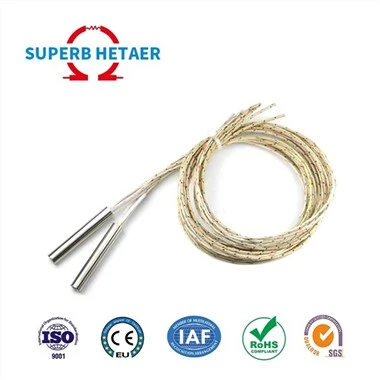
What are the effects of the welding process of stainless steel electric heating ring on welding quality?
Leave a message
Different welding process parameters and methods will affect the welding quality of stainless steel electric heating rings in terms of weld formation, welding strength, thermal impact, etc., as follows:
Welding process parameters
Welding current: If the current is too large, the weld penetration will increase, resulting in overheating of the base material of the stainless steel electric heating ring, expansion of the heat-affected zone, easy deformation, and even possible burning through the weldment; if the current is too small, the weld penetration will be shallow, and defects such as incomplete penetration and slag inclusion will appear, reducing the welding strength.
Welding voltage: If the voltage is too high, the arc length will increase, and the heat will be dispersed, which will increase the weld width, reduce the penetration, and deteriorate the weld formation. It may also lead to insufficient stiffness of the shielding gas, air intrusion into the welding area, and produce pores; if the voltage is too low, the arc is unstable, and it is easy to produce spatter, which will also affect the weld formation and quality.
Welding speed: If the speed is too fast, the weld cooling speed will accelerate, which is easy to produce hardened structure, increase welding stress, and may also cause problems such as incomplete fusion and poor weld formation; if the speed is too slow, the welding heat input will be too large, resulting in serious deformation of the weldment, coarse grains, and reduced mechanical properties of the weld.
Welding method
Tungsten inert gas welding (TIG welding): This method has stable arc, concentrated heat, good protection effect, can effectively prevent weld oxidation and nitridation, high welding quality, beautiful weld shape, especially suitable for welding stainless steel thin plates, can obtain high-quality welds, reduce heat-affected zones and deformation. However, the welding efficiency is low, and multi-layer and multi-pass welding is required for thick plate welding, which is prone to defects such as interlayer infusion.
Melting inert gas shielded welding (MIG welding): It has high welding efficiency and fast deposition speed, and is suitable for welding medium and thick plates. Due to the use of inert gas protection, the weld quality is good and there is less spatter. However, when welding thin plates, if the parameters are not properly controlled, burn-through and deformation are likely to occur; and the equipment is complex and has high requirements for the welding environment. Windproof measures need to be taken when welding in a windy environment, otherwise it will affect the protection effect and produce defects such as pores.
Stick arc welding: It is flexible to operate and can be used for welding in various positions, but the welding efficiency is low and the weld quality is greatly affected by the welder's operating skills. If the welder is not skilled in operation, defects such as arc instability, undercut, slag inclusion, and porosity are prone to occur. In addition, the electrode coating will produce more slag during the welding process. If it is not cleaned in time, it will affect the appearance quality of the weld and may also cause slag inclusion defects.
Plasma arc welding: concentrated energy, fast welding speed, small heat-affected zone, small welding deformation, and high-quality welding can be achieved, especially suitable for welding of stainless steel thin plates and ultra-thin plates. However, the equipment is complex, the cost is high, and the control requirements for welding process parameters are strict, requiring professional operators. If the parameter settings are unreasonable, welding defects such as porosity and incomplete penetration may occur.
Welding sequence
Reasonable welding sequence can reduce welding stress and deformation. For stainless steel electric heating coils, if the connection point between the heating wire and the lead wire is welded first, and then the fixed point between the heating wire and the substrate is welded, the heating wire can be freely stretched and retracted during the welding process, reducing deformation caused by welding thermal stress. On the contrary, unreasonable welding sequence may lead to welding stress concentration, large deformation of the weldment, and even cracks, affecting the dimensional accuracy and performance of the electric heating coil.
Welding environment
The temperature, humidity and wind speed of the welding environment have an important impact on the welding quality. If the ambient temperature is too low, the weldment will cool too fast, increase the welding stress, and easily produce cracks; if the humidity is too high, the weldment surface and welding materials will absorb moisture, forming pores during the welding process; if the wind speed is too high, it will destroy the protective effect of the shielding gas, allowing air to invade the welding area, causing weld oxidation, and producing defects such as pores and slag inclusions. Therefore, the welding of stainless steel electric heating rings is usually required to be carried out in an environment with a temperature not lower than 5℃ and a relative humidity not higher than 90%, and windproof measures must be taken, such as setting up a windshield or welding indoors.